

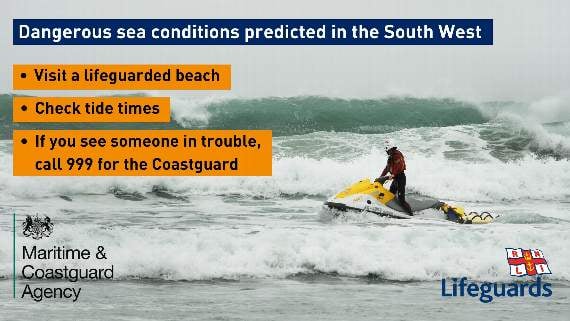
The RNLI and HM Coastguard are urging people to visit lifeguarded beaches and take extra care today (Friday) and Saturday as forecasts predict dangerous sea conditions, involving large swells, strong winds and spring tides.
These conditions, alongside large spring tides, can result in a dangerous sea state and increase the risk of strong rip currents.
If you see a red flag at a lifeguarded beach, do not enter the water, as it is unsafe for any water activities. If there are no flags, there are no lifeguards.



Spring tides and surging waves mean people could very easily get cut off by the incoming tide.
Anyone heading to the coast is reminded of the importance of checking the tide times and ensuring they have enough time to return if they decide to venture further along the beach.
Steve Instance, RNLI water safety lead for the south west says: ‘When we experience conditions such as this, especially during the summer when the region is busy with visitors, it is incredibly important that those heading to the coast keep themselves safe by choosing a lifeguarded beach and visiting within the patrol hours of 10am to 6pm.
‘With changeover days for holidaymakers on Fridays and Saturdays, those arriving to the area may not be up to date with local news and forecasts so could be caught unaware of the conditions.
‘RNLI lifeguards are there to offer advice so if you are unsure about anything, make sure you ask a lifeguard.
‘They will be able to provide information on tide times and guide you to the safest area to swim which will be between the red and yellow flags.
‘Anyone surfing should know their limits and always stay within the black and white flagged area.’
Director of HM Coastguard, Claire Hughes, says: ‘We’ve seen so many times how easy it is to get caught out by the sea.
‘Make sure you are always contactable at the coast by carrying a fully-charged mobile phone and if you get into trouble or see someone else in trouble, call 999 and ask for the Coastguard.’
If you find yourself caught in a rip current, please adhere to the following safety advice:
Swim parallel to the shore until free of the rip and then head for shore
Do not try to swim against the rip current or you’ll get exhausted
Always raise your hand and shout for help
Key facts about the RNLI
The RNLI charity saves lives at sea. Its volunteers provide a 24-hour search and rescue service around the United Kingdom and Republic of Ireland coasts. The RNLI operates over 238 lifeboat stations in the UK and Ireland and, in a normal year, more than 240 lifeguard units on beaches around the UK and Channel Islands. The RNLI is independent of Coastguard and government and depends on voluntary donations and legacies to maintain its rescue service. Since the RNLI was founded in 1824, its lifeboat crews and lifeguards have saved over 142,700 lives.
Comments
This article has no comments yet. Be the first to leave a comment.