

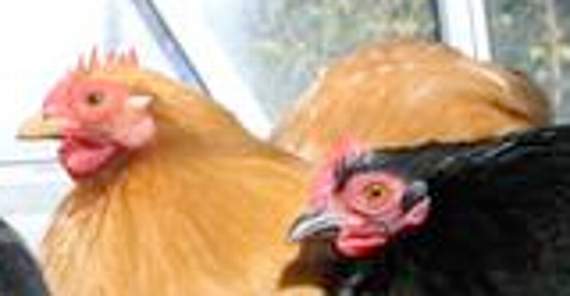
A WARNING to quarantine poultry inside for 30 days to deter an outbreak of avian flu has gone down like a stuffed turkey in Teignbridge. Keepers of ducks and chickens have clucked their disapproval of the government’s ‘totally impractical’ advice.
One Bovey Tracey smallholder’s restrained response to the ‘diabolical’ order from the Department for Environment, Food and Rural Affairs (Defra) was typical. He barked: ‘I keep a mixture of poultry - chickens and ducks - about 70 in total. Most of them roam free during the day and go into small coops at night.
‘It’s just not practical or humane to keep them cooped up all the time.’ He added: ‘I don’t have any large buildings available to keep them inside 24 hours a day, and I’m sure this is a common problem.’
Last week the UK was warned about a new outbreak of a highly infectious strain of bird flu in Europe. No cases have yet been reported in the UK. The H5N7 strain, already detected in France and Germany and Holland, is easily spread through wild, domestic and farmed birds. Poultry keepers, no matter how large or small scale, in the UK have been advised to keep all poultry inside for the next 30 days as a prevention strategy.



Another chicken keeper, on Dartmoor, said: ‘We don’t have that many chickens - but there is no way we can house them indoors. We just don’t have the space. We would like to comply with Defra, but it’s just not possible. I might be able to put some netting up to give them greater protection from possible infection. Nothing else.’
He added: ‘I’m sure the large commercial operators may be able to accommodate the demand - but small-scale keepers like me are on a hiding to nothing.’
Andrew Bucher, Chief Veterinary Officer at MedicAnimal, the UK’s leading online retailer, advised: ‘It may sound silly if people only have a couple of chickens - but they should make sure they register them. If the disease reaches the UK it is crucial that its effect is monitored.
‘Keepers need to take steps to remove any direct contact of their birds with wild ones quickly and instal a biosecurity program to minimise the indirect contact.’
He said: ‘Pathogenic flu epidemics can spread exceptionally rapidly by many people not following basic hygiene and biosecurity procedures.
‘If people are able to avoid direct contact between their domestic and wild birds, they should remember that indirect contact occurs by faecal contamination of ‘fomites’ including feed, water, utensils, clothing or equipment.
‘A prevention strategy is not saying we should be putting chickens away in dark, uncomfortable spaces for 30 days.
‘Simple fencing and netting can be used around the coop to help minimise the risks. It’s just as much about keeping wild birds out as keeping birds in.’
Comments
This article has no comments yet. Be the first to leave a comment.