

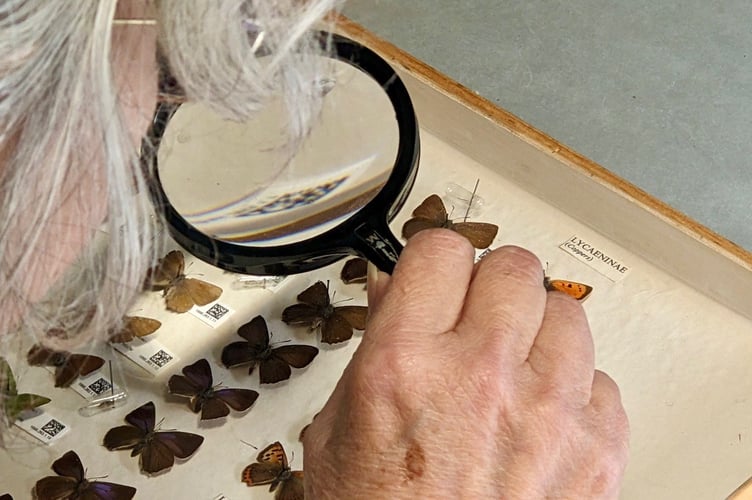
A NATIONALLY important collection of 3,000 butterflies and other insects at Newton Abbot Museum is to see the light of day again.
The Dr Henry Mapleton Collection dates from the 1890s to the 1930s and was partly gathered in and around Newton Abbot.
Some of the species familiar to Victorian and Edwardian eyes are now extinct or have had to be reintroduced.
So significant is the collection that it was the first from a small museum anywhere in Britain to be included in a unique digitisation experiment with the Natural History Museum, London.

Specimens are being photographed and shared with a global academic audience as it’s thought the ecological time bubble could provide insights into climate and environmental change.
The exhibition, which starts on March 17, provides a chance to see many of the insects catalogued by Dr Mapleton.
Curator Joanna Eccles said: ‘This collection of butterflies, moths and other insects, is nationally significant and very fragile.
‘To protect it during the construction of our new store, we have brought the two cabinets into the museum for visitors to explore and enjoy.
‘The exhibit also highlights how Newton Abbot Town Council, a pesticide-free authority, is working to improve and protect local habitats by means such as creating wildlife-friendly roadside verges.
‘All of the boards in this exhibition are made with recycled, recyclable material.’
It is hoped the new museum store, construction of which is imminent, will provide better protection for artefacts such as Mapleton’s insects, and create more volunteering opportunities.
‘Over the years, this collection has encountered one of the most common challenges faced by museums, pest damage, ’said Ms Eccles.
‘Although the infestation has been fully treated, you may notice traces of the pests past activity within the drawers.
‘The specimens are now receiving careful conservation. Any loose fragments are being collected and placed into clear capsules so that their scientific information is preserved for future study.’
Comments
We've recently changed our login process. If you have an account for commenting, you will need to re-register on the login window.
This article has no comments yet. Be the first to leave a comment.