
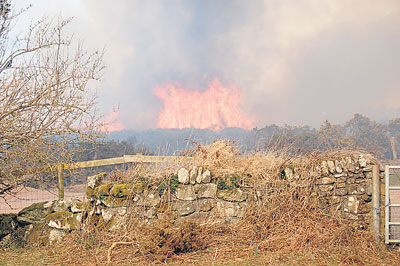
Plumes of thick smoke seen drifting over the district this week was the result of swaling on Dartmoor.
The practice is carried out by commoners to promote growth of new heather which provides a valuable wildlife habitat.
Swathes of land are deliberately burned under controlled conditions. To protect ground-nesting birds no swaling is allowed after March 31, hence the increase in activity before the deadline.
At one site on Halshanger Common a change in the wind conditions on Tuesday left motorists struggling to see the road ahead.



Flames up to 30ft high licked close to the lane, the heat able to be felt through a closed car window.
Dartmoor's principal access and ranger officer, Andrew Watson, said the spectacle was all part of the moor's annual cycle.
'It does look a bit drastic to see large areas of the moor on fire but in a year or two the heather will have re-established itself and be good for birds like the skylark,' he said.
'There is a code of conduct which the commoners must adhere to, such as informing us and the fire service beforehand.
'Because of the reduction in grazing in recent years the growth of scrub has increased and more swaling is carried out now.
'What I would say, of course, is that anyone spotting large plumes of smoke rising from Dartmoor after April 1 should call the fire brigade immediately because it certainly shouldn't be caused by swaling.'