
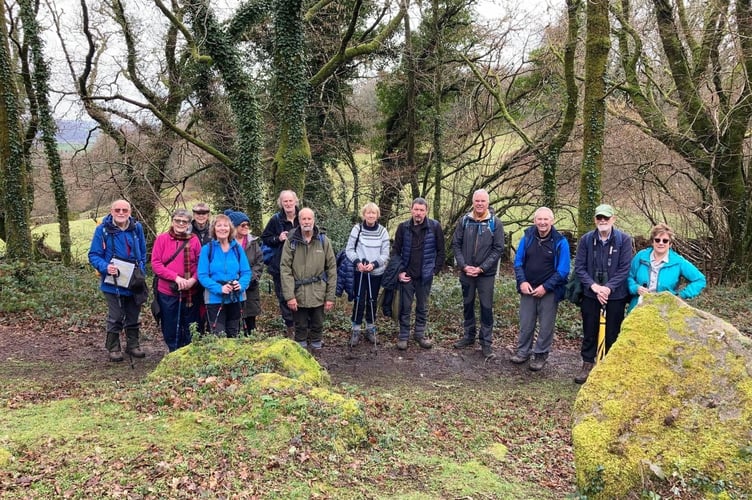
ON Tuesday, Jane led a ‘Billings Special’ over Dartmoor. Starting from Cold East Cross the walk to Rippon Tor, Saddle Tor, Top Tor and Buckland Beacon was shrouded in mist and rain. Nonetheless the great company of friends – at least twelve intrepid walkers – made it all worthwhile.
The weather on Wednesday was not very promising either and only six walkers made it to Bampton for Geoff Sharp’s walk.
However, after a wet drive up to Bampton the weather cleared and an enjoyable walk was had, visiting Coldharbour Farm, Morebath, Claypits, Loyton, Shillingford and Ford Mill – a new area for the group.
By Thursday the weather had improved and stepping in to lead the walk Ron and Jenny started off from Trendlebere Down.


The descent through the woods led to the picturesque packhorse bridge at Hisley Bridge. It was then uphill through Lustleigh Cleave to the Nut Crackers where Ron allowed the group to have a breather while he told them all about the logan stone.
In the early 1900s William Crossing briefly mentioned that on Sharp Tor there was a logan stone called the Nutcrackers along with several more stones that ‘log’ or rock. The reason why the name Nutcrackers applies is that there were three stones and the motion of one of them caused the other two to ‘log’. Sometime in 1950 the rock was dislodged and despite efforts to reposition it there has been no success. So no nut cracking today.
The walk continued to the lovey village of Lustleigh where lunch was taken in the Orchard before returning to the Cleave and the climb back to the cars.
Mike Strickland led the monthly café walk; this time a three mile walk around Shaldon. Starting at beach level the group walked through the village to substantially built St Peter the Apostle Church and then onto the playing fields. Crossing back over the main Torquay road the gem of Homeyards Botanical Gardens was entered. The gardens were created by Maria ‘Laetitia’ Homeyard in the 1920s on the proceeds from “Liqufruta” which was used to treat bronchitis, asthma and whooping cough.
The well maintained gardens are now in Local Authority ownership and feature an Italianate Garden, a witches cave, pond with a rill and the castle is soon to reopen to serve informal refreshments.
After a good look around the gardens, with time to enjoy views of the estuary under bright blue skies, the group returned to Shaldon to enjoy afternoon tea in the Clipper.
Disappointed to have to cancel her walk earlier in the year Wendy was pleased to see twenty two walkers turn up for her rearranged nine mile walk from Bovey to Lustleigh.
Quick progress was made by the walkers along the disused railway and lanes to Wrayland. The Moretonhampstead and South Devon railway was opened in 1886 and ran until 1964, no doubt a casualty of Mr Beeching’s cuts, but it is now a great amenity for walkers and cyclists alike.
Wrayland was once a separate settlement, but is now part of Lustleigh. The closely packed thatched cottages date from the sixteenth century and looked beautiful on each side of the narrow winding lane that leads into the main village where church bells welcomed the group.
Leaving the village via Mill Lane there were more picturesque buildings to enjoy amongst the spring flowers. Daffodils, primroses and camellias were all out and despite the cold wind they did make you feel spring had arrived.
The impressive stone gatehouses of Forder Gardens on the outskirts of Parke were soon reached. Built in 1898 by the Right Honourable Sir Harry Trelawney Eve JP, a barrister and MP, his intention was to build Forder Gardens for his son.
Because his son was killed in action the main estate house was never built and only the 2.5 acre walled garden and gatehouses were completed.
Skirting around the outer edge of Parke advantage was taken of the felled trees (perhaps due to ash die back) to provide plenty of seats for lunch.
But, the cold wind meant it was a short stop and it was onward to a stretch of the Templer Way where the granite rails could still be seen.
On the way Challabrook Cross was spotted by the path near Challabrook Farm.
A plaque on the cross states ‘This old cross once marked the grave of a Royalist Officer who fell near here in 1645 when Cromwell’s troops defeated the Royalists. AJW 1923’
However, according to E Masson Phillips in 1933 this was a ‘fanciful assertion’ – we shall never know, but there were certainly such battles in the area.
Chris Bovey was also able to enjoy the good walking weather on Sunday when she led her group of twelve from Ottery St Mary.
The cold easterly winds had dried out much of the recent mud and the flat walk along the river to Tipton St John was enjoyed by all.
Much of the wealth of Ottery St Mary was based on the woollen trade.
Towards the end of the eighteenth century one of the world’s first water-powered factories was built for carding and spinning wool using the recently invented water-frame machinery.
The new mill was built on the site of an older corn mill, but as the head of water was insufficient for the new mill the water level in the mill basin had to be increased by 2.4m with the water level being maintained by a circular tumbling weir. The mill and weir are still in place and make quite a spectacle.
For more information about the many other walks offered by Newton Abbot & District Ramblers see www.newtonabbotramblers.org and come along and enjoy good company.