
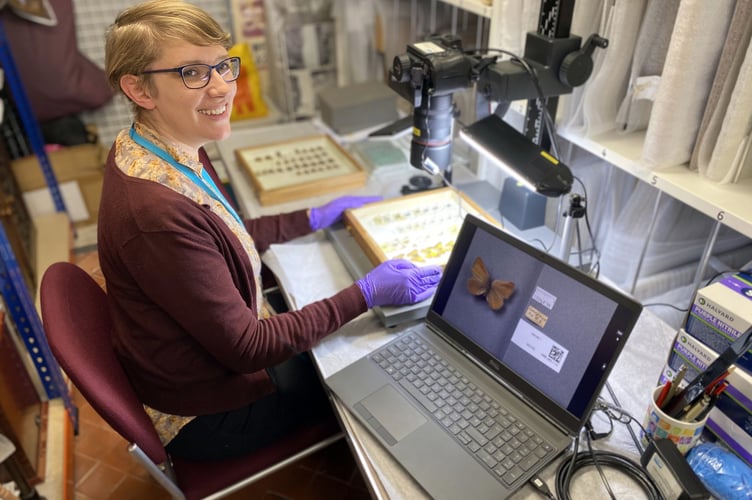
A RARELY-SEEN collection of insects at Newton Abbot Museum is to be given a global academic audience thanks to a unique experiment with the National History Museum, London.
Numbering approximately 3,000 specimens, the moths, butterflies and other invertebrates in the entomology grouping were collected more than a century ago by Dr Henry Mapleton, Medical Officer for Health with Newton Abbot Urban and District Council from 1890 to 1932.
Most were taken from the local area and some examples, such as the Large Blue butterfly, are now thought to be extinct.
Much of the ecological time bubble, which could provide insights into climate and environmental change, has only rarely been seen.



Some labels, containing vital biodiversity clues, were last viewed in the late 18th and early 19th centuries.
South West Area Natural Sciences: Setting Natural Science Collections Data Free, is a collaborative pilot project between the Natural History Museum, South West Museum Development and Bristol Museum & Art Gallery.
It will enable museums to digitally share their natural science specimens and associated data, helping researchers worldwide to understand more about biodiversity and the influence of humanity on our rapidly changing planet.
Newton Abbot Museum, funded by Newton Abbot Town Council, is the only small museum in the country to be selected at this stage.
‘Working with a large national body that has the knowledge and resources to help us achieve this level of digitisation and collections care is very exciting,’ said curator Dr Charlotte Dixon.
‘We had already decided to better catalogue our collection and identify those species which might be extinct and had applied for a grant through the South West Museum Development scheme funded by the Arts Council England.
‘We were successful and the conservation officer then put us through for the National History Museum’s project which we only learned about later.
‘Now we’re the only small museum so far involved and we’re really delighted about that, it is a fantastic opportunity.’
Staff from the Natural History Museum visited Newton Abbot to offer training and provide the high-resolution photographic equipment required for the job.
Curatorial Assistant Lucy Cokes, who joined the Newton Abbot Museum team just a month ago, has been involved.
‘This is really exciting, I’ve never had the chance to do something like this before and I’m a great nature lover,’ she said.
‘It will be very interesting to contribute to our collective knowledge and it enables me to use my skills in conservation which include being very delicate with the specimens.
‘We’re also working with a team of volunteers, expanding their skills, so that’s great.’
Comments
This article has no comments yet. Be the first to leave a comment.