
Live music is something very special, writes Jeff Collman
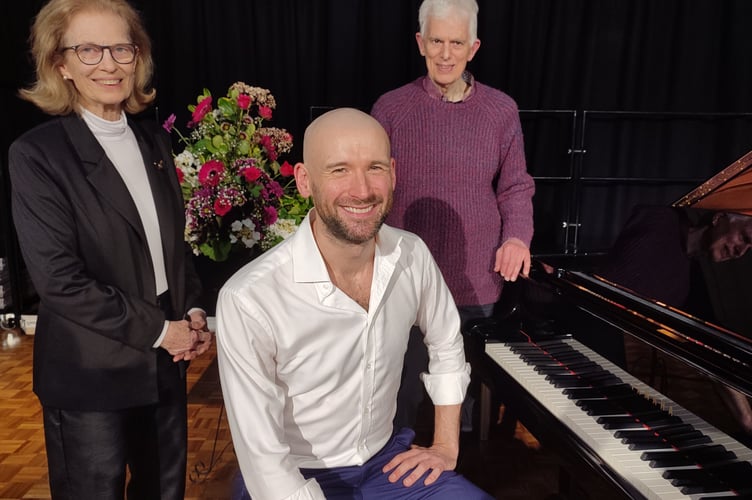
John Paul Ekins lit a torch for the genre last Friday for the final concert of the NADSA season Newton Abbot’s Courtenay Centre. His welcome to the audience with his clear, enthusiastic, informative and sympathetic introductions put the music in context of the composers’ different characters. We felt the subsequent performances were three-way shared experiences.
His programme featured the last piano compositions of three great composers: Mozart, Brahms and Schubert.
In spite of Mozart’s problematic personal life, his compositions were generally uplifting and jovial; thus, we were well prepared for John Paul’s bright attack in the Allegro of Sonata No 18 [Mozart’s last piano work].


The Adagio was an abrupt change of sentiment and style; a reflection of Mozart being no stranger to traumatic disappointment and hardship. The final Allegretto was light and joyous. John Paul had imperceptibly melded the classical form and frivolity of Mozart with the contrapuntal influence from J S Bach which enrich this magnificent sonata.
When, as an old man, Brahms was composing his last four piano pieces, he was very aware of his own mortality, thus we were given to expect depth and introspection. John Paul told us that the first three are titled ‘Intermezzo’, a term usually applied to an interlude, or something between the acts.
Brahms, in correspondence with Clara Schumann, wrote that the first piece ‘is exceptionally melancholic’. In those days, we were informed, melancholia was recognised as a temporary state which would pass. So how would our intellectual expectation be satiated by the musical performance? Amazingly!
There was poignant delicacy and palpable restraint in the first Intermezzo, and, as we journeyed through the second and third, it was as though the reins of life were gradually being loosened. The Rhapsody’s affirmative entrance gave way to more reflective passages and ultimately a monumentally triumphant finale.
Unlike Mozart, Schubert was aware that he was dying even when he was in his late 20s. In 1823, shortly after he had been diagnosed with syphilis, he wrote Sonata D784, characterised as ‘without hope’. Schubert’s Sonata in B flat D 960 [which we were to hear] was his last composition for piano, and is perhaps more easily characterised as having ‘moved on’.
The journey through varying reflective moods with different tempi, keys and dynamic was riveting. From serenity to high drama, the gamut of human emotions was there, and how brave of Schubert to end with exuberant chords.
The audience voted not to have an encore, ‘what could possibly follow that?’ being the general consensus. Superlatives were flowing.There can be an intensity at a live performance which in part depends on audience reaction.
Where this becomes most evident is at pauses: does the performer carry us through the silence as an integral part of the musical drama?
John Paul Ekins certainly took his audience with him: a consummate performer.
Comments
This article has no comments yet. Be the first to leave a comment.