

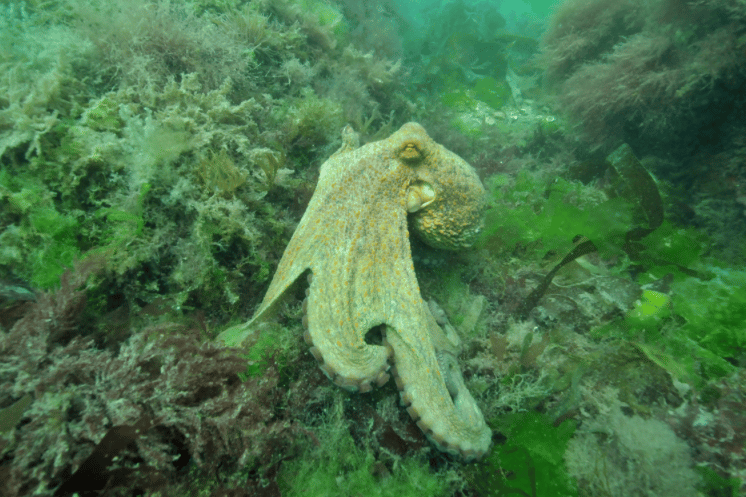
A SURGE in the Octopus population is likely to continue impacting the livelihood of crab and lobster fishers around the south coasts of Devon and Cornwall, a new study has revealed.
Leader of Plymouth City Council Tudor Evans (Lab, Ham) called the Octopus bloom in South West waters which has accelerated from January 2025 “a crisis for our local fishing industry” as now the science has backed up local concerns.
The unusual event is thought to be down to warming seas providing a clear link to climate change.
The study funded by Plymouth City Council, Devon County Council and Defra and led by a coalition of scientists was called for after Plymouth fishers reported that their usual crab and lobster catches were replaced by octopus and they remains of what they hadn’t eaten.
.png?width=209&height=140&crop=209:145,smart&quality=75)



There were also reports of shellfish fisheries being decimated off the coast of south Devon and South Cornwall.
Scientists from the Marine Biological Association, University of Plymouth, Plymouth Marine Laboratory, and Blue Dog Consulting reveal in their report that the bloom is continuing, is “the most impactful one in over a century” and poses a “significant and complex challenge to marine ecosystems and the fishing industry”.
According to the Marine Management Organisation (MMO), over 400 tonnes of octopus were landed in May 2025 alone – a figure unmatched in UK records. Prior to this year, monthly landings rarely exceeded 75 tonnes.
The common octopus is native to UK waters but is typically rare, favouring warmer seas further south in Europe and the Mediterranean.
Only four major population ‘blooms’ have been recorded in the past 125 years: in 1899-1900, 1932-33, 1950-51, and now since 2025.
The research team found that unusually warm sea temperatures during bloom years and the preceding year were a consistent factor in all recorded blooms. Sustained easterly winds may have helped transport young octopus larvae from the Channel Islands and northern France. Ocean current modelling supports this, showing that larvae from Guernsey, which has seen its own octopus bloom since 2024, likely contributed to the UK surge.
A survey of 40 fishermen revealed mixed impacts from the octopus surge. While some adapted to catching octopus and benefited economically for a period of time, over half reported negative impacts, particularly those targeting brown crabs, lobsters and scallops, which suffered heavy predation from the octopus.
Catch rates for those species dropped by 30% to 50% in 2025. Concerns are therefore growing about long-term damage to crab, lobster and scallop stocks.
Cllr Tudor Evans , said: “This is a crisis for our local fishing community. Our fishers felt the pressure of the bloom earlier this year and now the science backs up what they have been telling us: the octopus bloom is not a blip – it’s a sustained threat.
“We need to move beyond reactive measures and there needs to be serious investment in predictive tools and support to help fishers to adapt and safeguard a fishing fleet for the future. This is not a one-season issue. It’s a long-term challenge that demands a long-term fix.”
Plymouth crab fisherman Brian Tapper said his catch had gone down drastically and his business was not currently financially viable.
“We used to have a tonne of crab a day but have not had a tonne all year. I’ve tied the boats up and the crew have left because there is no income. The octopus eat everything in site, they are like locusts.”
A fisherman of 39 years, Mr Tapper said he was now in debt but would have one more bash next season. He said his Cornish colleagues were also struggling.
Cllr Julian Brazil (Lib Dem, Kingsbridge), leader of Devon County Council, said: “These findings are a concern, and it justifies the urgency in carrying out this vital research at the earliest opportunity. The study has highlighted that the influx of octopus on our waters is an issue which is likely to be increasingly frequent. Attention must now focus on how best to support the needs of our fishing communities and local marine life.”
Dr Bryce Stewart, senior research fellow from the Marine Biological Association, added: “If these conditions persist, octopus blooms could become a more regular feature of our changing seas. Understanding their causes and consequences is vital to help both ecosystems and coastal communities adapt.”
The report recommends expanding monitoring programmes, developing predictive models and creating tools to help fishermen report octopus impacts more easily. It also calls for guidance on humane handling and dispatching of octopus.
With climate change likely to increase the frequency of such blooms, researchers stress the need to understand how sudden influxes of species like octopus affect ecosystem resilience.
Comments
This article has no comments yet. Be the first to leave a comment.