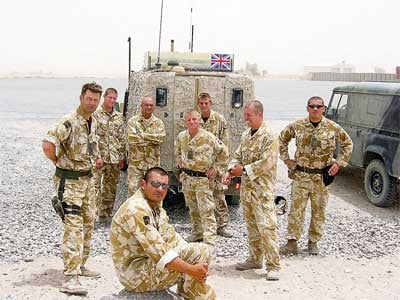
On Friday morning I went on patrol in Az Zubayr with Major Matt Maynard's Rover Group. The aim was to check on the location and quality of the Iraqi Police Force (IPF) check points, as part of the long-term plan to bring them up to scratch. Maj Maynard, 34, from Christchurch has been trying to get the police to shift their check points to outside the town as Shia death squads are able to get in unhindered. They were reluctant, he said, at least in town the poorly-resourced force could get a drink and a bit of shade. Before setting off we were given an intelligence update. The previous night, the old state building had been mortared in Basra, two rockets were fired at the Shatt Al Arab Hotel, Basra Airport had come under attack and soldiers had engaged 200 rounds after the boat patrol in Basra city was fired on. No casualties. Thirteen Sunnis had been assassinated and many more had received death threats in retaliation to a Sunni suicide bomb at Najaf – the Shia holy shrine a few days previously. Then out into the scorching wind, we piled on the body armour and already sweating, clambered aboard the Snatch vehicles. Roadside bombs cause the main danger of British troops, so patrols use the roads as little as possible, picking their way across a maze of desert tracks. This is not Lawrence of Arabia country. The terrain is hard and ugly, more like builder's rubble, littered with the remains of Saddam's tanks. The dreadful state of Az Zubayr comes as a shock. Whole areas are in ruin, what housing there is is unbelievably primitive. Dogs scavenge among the piles of rubbish and noxious pools of liquid. As we go by, bare-footed children wave and call out, men lift their hands in greeting or give the thumbs-up. As we approach 'two mosque roundabout' the patrol stops so that soldiers can check the area on foot, looking for wires or antennae. The vehicles creep forward and one soldier is shouted at for moving ahead too quickly beyond the protective bubble of the vehicle's technical gadgetry. To the right is the Sunni mosque, to the left the Shia mosque. Maj Maynard tells me that they suspect Shia militias of using it for covert activities. 'If we went in there we'd just cause holy hell,' driver Cpl Stephen Pye remarks. A gaggle of children run up in the hope of a bottle of water or a few cents. Getting a refusal, one, more determined than the rest, points at the felt tip pens lined up on the front of the major's body armour. A couple of closely-parked lorries look suspicious and two soldiers go over to check them out. Nothing to worry out, we're told – they're just farmers picking up grass for their sheep. No sooner had we got back than Maj Maynard was called out again by the city police chief to take three men into army custody. The three had been stopped at a police checkpoint carrying AK47s. They claimed to be off-duty customs police. The police chief, Col Ali, suspected them of being the Governor of Basra's personal death squad. The governor is widely suspected of being involved in the intimidation and assassination of Sunnis. Being an elected official there is little the multi-national force can do. 'He is a very distasteful individual and has an army of henchmen who are at best thugs and at worst assassins,' said Maj Maynard. But by the time they arrived, Col Ali's superior had already applied pressure to get the men released. 'It's very frustrating,' he admitted. But the good news, he said, is that the problem is now recognised in London and Baghdad.