
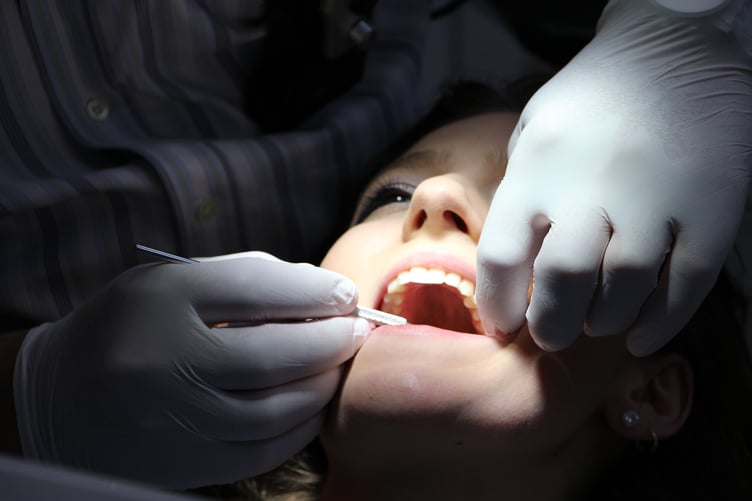
JUST five dentists have taken up a major financial incentive to recruit them to positions in the county amid efforts to improve the county’s oral health.
A national ‘golden hello’ scheme that pays NHS dentists £20,000 to relocate to underserved areas has seen just a handful recruited in Devon in the first two years of the scheme.
The payments, which are made in instalments over three years, only seem to have had a limited effect, and a recent NHS report reveals that 15 posts remain vacant in Devon that attract the £20,000 payment.
While recruitment efforts are ongoing, just two dentists took up the scheme in 2024/25, and three in the 2025/26 financial year.




A spokesperson for NHS Devon said additional ‘golden hello’ applications had been approved but that a number of providers ‘have since paused or stopped recruitment for those posts’.
The figures, revealed after a request by the Local Democracy Service, come as fresh details and data emerged about the state of Devon’s oral health and its ability to visit a dentist.
At Devon County Council’s health and adult care scrutiny committee, it was stated accessibility to a dentist had fallen by around eight per cent in Devon.
Jonathan Bouwer-Davies, a clinical dental adviser for the NHS, said the total number of people in Devon who had seen a dentist in the 2025/26 financial year dropped to 394,000 from 430,000 the previous year.
Virtually the entire drop related to a fall in the number of adults able to see a dentist, while the 127,000 figure for children was broadly flat.
That meant only 32.6 per cent of the population had seen a dentist, down from 35.6 per cent, meaning there was a “widening gap on access”.
Mr Bouwer-Davies said there were some changes around the dental contract that had caused issues, but said initiatives such as getting some patients with good dental hygiene to have checks every two years rather than six months could enable more people to be seen.
He added there were recruitment efforts beyond the ‘golden hello’ scheme, including analysing the number of places available at dental schools.
Mr Bouwer-Davies added new dental contracts had been signed to help improve provision in areas of greatest need, with the annual value of these at around £5 million – equivalent to 109,000 units of dental activity.
This extra provision is clearly needed, given the health service stated that more than 20 per cent of five-year-olds in Devon have tooth decay despite it being preventable.
‘Oral health is an important aspect of a child’s overall health and wellbeing, directly affecting eating, speaking and socialising, as well as school attendance,’ the service said in a report.
The committee’s chair, Councillor Jess Bailey said she felt the NHS report lacked enough rigorous data for her committee to be able to fully ascertain the state of Devon’s oral health.
She asked the NHS for a more comprehensive report at the committee’s next meeting in September.
‘The lack of data makes it hard to know the scale of the challenges,’ she said.
‘I believe that in areas of deprivation it is worse, but we don’t have that in a report, and given the reduction in access to dentists I think we need a full report from the integrated care board (ICB), particularly given the financial challenges of that organisation and how efforts to save money could potentially impact on services commissioned.
‘I am requesting you to come back to the next committee with a full detailed report setting out where the challenges are in the county and what you are doing to overcome them.’
Comments
This article has no comments yet. Be the first to leave a comment.