

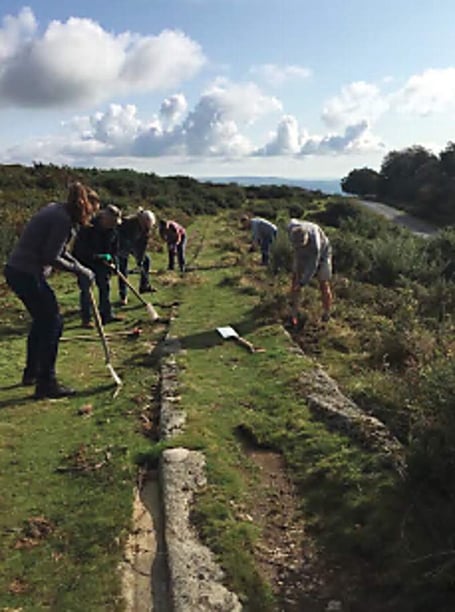
A GROUP of volunteers has resumed its efforts to unearth a slice of Dartmoor’s industrial archaeology.
Until the pandemic members of the Haytor Second Sunday group had met every month at the moorland beauty spot since 2016 to carry out conservation work and help National Park Rangers with jobs such as erosion repairs.
One particular task they returned to regularly was the clearing of the historic granite tramway.
The structure, known correctly as a railroad, was built in 1820 by businessman George Templer as a means of transporting quarried stone some seven miles to the Stover Canal at Ventiford Basin.



But having been abandoned for more than a century it was in danger of disappearing under gorse and encroaching soil, meaning visitors could struggle to appreciate the landscape’s industrial past.
The process of uncovering the hand-hewn rails came to a halt last year owing to social distancing measures but earlier this month the Second Sunday team – they meet on the second Sunday of each month - took up their tools once more and got to work.
‘It was fantastic to have the crew back together again, albeit in a somewhat smaller form than we’ve had in the past,’ said Bill Allen, Sector Ranger with Dartmoor National Park Authority.
‘This was our first real task for everyone to get their teeth into and the progress they made was terrific.
‘Our archaeologists are keen that people understand the Haytor landscape is one shaped by human activity and had the railroad disappeared that connection would have been lost.
‘To see the rails emerging once more is wonderful and I congratulate the Second Sunday team on their efforts.’
Other work undertaken by the group has included habitat improvement to boost rare butterfly numbers and improving access for mobility scooter users at Haytor Quarry.
‘We’ve had as many as 42 people join us for Second Sunday events so their contributions to this precious area seriously add up,’ said Bill.
‘We’re not able to take any more volunteers at Haytor for the moment but other opportunities are available elsewhere on the moor.
‘Visit www.dartmoor.gov.uk and take a look.’