

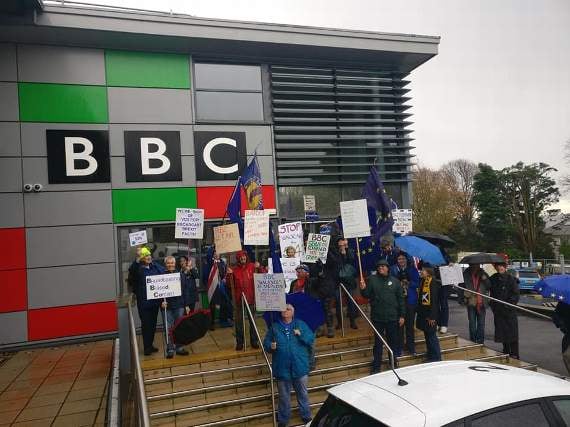
Pro EU protestors from South Devon demonstrated outside BBC Plymouth buildings on Saturday, November 10, against the Beeb's 'bias’ towards reporting on Brexit.
Supporters of the grassroots organisation Devon for Europe braved torrential rain to display banners and placards reflected their disappointment in the ‘lack of impartiality’ from the national broadcaster.
Anthea Simmons, of the group, said: ‘We’re all frustrated and disappointed by the bias the BBC has shown in its handling of the Brexit issue.
‘Yes, there was a very small majority for leaving the EU in 2016, but all the polls indicate that the people of the UK want a People’s Vote now that the negative impact of Brexit has become much clearer.




‘The BBC has failed to reflect this fact and has often treated People’s Vote advocates with disdain whilst ‘Brexiteers’ have been able to promulgate their myths unchallenged.
‘Was the time given to MP Jo Johnson evidence of a shift? We can only hope so, because Brexit can be stopped and a People’s Vote is both possible and desirable. Brexit is not a done deal and the BBC has been wrong to imply that it is all over. It isn’t. Democracy did not end in June 2016.’
Anthea said Devon for Europe was ‘driven to demonstrate’ by the cumulative impact of a succession of BBC editorial decisions. These claims include providing under-investigation Brexit-backer Arron Banks with a platform on the Andrew Marr Show; the absence of pro EU UK MEPs on Question Time since 2013; the air time given to think tanks such as the Tax Payers’ Alliance; and the ‘woeful coverage’ of Devon for Europe’s activities and the false equivalence accorded much smaller pro-Brexit events.
In response to the Devon for Europe claims a BBC spokesperson said: ‘The BBC continues to report Brexit impartially and features a wide range of different perspectives across our news coverage. It is one of the reasons why the public trusts the BBC more than any other source of news.
‘Question Time is not a ‘single issue’ programme and panellists are expected to address a range of subjects each week. The BBC is no longer reporting on the binary choice, which faced the electorate in the referendum over two years ago.
‘Question Time gives audiences the opportunity to hold to account politicians from government and opposition parties for the way they are carrying out Brexit. Aside from politicians, the rest of the panels consist of political commentators, journalists, and other public figures who represent a range of viewpoints across a series.’