
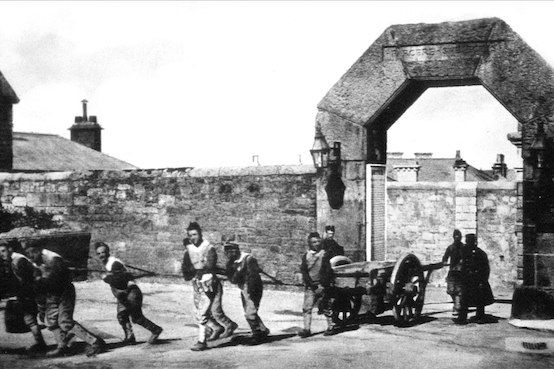
DARTMOOR Prison once relied on teams of inmates sent onto the open moor to cut peat for fuel, hauling thousands of tons back to the prison during the 19th Century.
Today, the land has been restored and forms part of the vital landscape that feeds the rivers and reservoirs South West Water now protects.
Across Dartmoor, faint lines cut through the moorland that do not belong to nature.
Through the mist, they look like the ghost of railway tracks, but are, in fact, the remains of tramways built nearly two centuries ago to move thousands of tons of peat cut by prisoners from Dartmoor Prison.

-and-Debbie-(R)-with-the-Dartmoor-Llama-Team[37].jpg?width=209&height=140&crop=209:145,smart&quality=75)

Jo Higgins, Historic Environment Officer with the South West Peatland Partnership, said: ‘Visitors to the remote uplands of Dartmoor might not be aware that these were once busy industrial areas.
‘Peat-cutters, tin-streamers, miners and military activity have all shaped the South West’s moors into what we see today.
‘Research commissioned by the South West Peatland Partnership as part of peatland restoration works helps to enhance understanding of historic and archaeological sites left by people on the moors’.
One of the most striking examples of that industrial past lies in the story of Dartmoor Prison.
In the summer of 1853, prisoners cut and secured 1,920 tons of turf in just five months. According to official reports it was “to be used as fuel, and for making gas for the prison”. At local prices, its value was estimated at around £800.
According to Dartmoor Prison Museum curator, Graham Edmondson, a report from the prison museum’s archive describes how ‘the peat which abounds near the prison will furnish heat… will generate gas of the purest quality, producing an effulgent light’.
Today, water that falls on the same ground feeds Burrator reservoir, supplying drinking water to South West Water customers. The prisoners, and those who supervised them, would have been oblivious to the long-term impact their daily grind would have decades later.
Dartmoor Prison first opened in 1809 as a war prison, holding thousands of captives from the Napoleonic Wars and the War of 1812 behind granite walls a mile in circumference.
It closed in 1816 and stood largely unused for decades.
During that gap, a local venture attempted to turn surrounding peat into naphtha, a flammable liquid. However, the fuel was poor quality and commercially unviable.
When the prison reopened in 1850 as a convict jail, peat cutting became routine.
Convict labour reshaped the land around the prison. Marsh ground was levelled and redirected to receive sewage from the prison buildings.
In the Report of the Directors of Convict Prisons (1865), the Governor made clear that peat cutting was part of a tightly controlled regime. He recorded:
“The parties proceed to the moor under escort, and the labour, though severe, is considered suitable employment.”
At the time, peat was valued for heat and light and was transported along horse-drawn tramlines such as the Omen Beam line to the Dung Hills.
Healthy peatlands remain waterlogged. They lock up carbon and release rainfall gradually into streams and reservoirs used to provide drinking water.
South West Water is a lead partner in the South West Peatland Partnership and the condition of upland peat directly affects raw water quality and long-term resilience. Catchments that hold water higher in the landscape are more stable during intense rainfall and prolonged dry spells.
Morag Angus, South West Peatland Partnership Manager, says land once cut to keep lamps burning is now being rewetted to protect water resources.
“It’s an amazing project and partnership to be part of, making our peatlands wetter and better for wildlife, water, people and the planet. Dartmoor’s peatlands are rich in archaeology and contain so much history. We’re working together to stop the peat from degrading further, carrying out surveys with our in-house archaeologists and commissioning research to learn more about these natural archives of human industrial activity.”
Restoration work now focuses on blocking drains, reshaping exposed peat and encouraging sphagnum moss to return. The aim is not to recreate the 19th Century, but to stabilise what remains and allow natural processes to function again.
More than 5,000 hectares of peatland across the South West have had restoration works to slow the flow of water, reduce erosion and create essential spaces for nature.
“There’s still so much more to be done, and there’s no time to lose,” said Morag.
“It takes time to tackle hundreds of years of degradation. Some benefits from restoration are immediate for wildlife and water like dragonflies breeding in new areas. But carbon-rich peat will take much longer to begin to form again in some places.”
For Graham Edmondson, there’s a quiet irony in the story.
“The prisoners weren’t thinking about climate or hydrology. They were cutting fuel under orders and the moor was seen as a resource to be used. The idea that those blanket bogs would today be recognised as a vital, living system that stores water and supports resilience wasn’t part of their conversation as they marched onto the moor. That contrast is what makes the history so striking.”
Comments
This article has no comments yet. Be the first to leave a comment.