

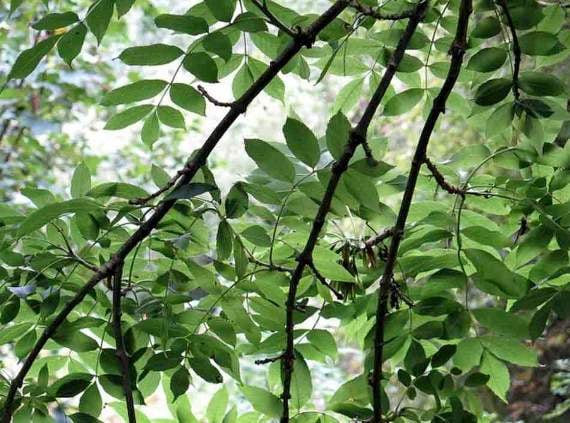
AMBITIOUS proposals to manage the risk of the Ash Dieback tree disease in Devon to ensure public safety were approved at County Hall last month.
The county authority agreed plans to increase its rate of tree inspections – initially to every two years – to cut the risk of falling trees and branches.
One in five of all trees in Devon are ash trees, and virtually all native ones are expected to succumb to Ash Dieback.
Cllr Stuart Hughes, Devon County Council cabinet member for highway management, said: ‘Ash Dieback represents a serious threat to Devon’s environment as well as being a threat to public safety.
‘The nature of Devon’s highways network with a high proportion of hedgerow trees, many of which are ash, means that the impact on public safety could be greater than for some authorities where the disease is more advanced.’
He added: ‘It is important that we make appropriate provision financially to take action to ensure public safety at the appropriate time. As the disease progresses over the next few years this will need to be monitored and reviewed.’
Council surveys from 2013 estimate there are 6,300 trees on highway land, 3,900 on county council land and 3,100 on school grounds.
The authority may have to spend some £2.5 million felling its own trees.
Across the Devon there are also around 440,000 ash trees owned by third parties or on unregistered land that are within falling distance of the highway.
The overall cost of felling all those which could affect the highway could be more than £70 million.
Landowners, responsible for ensuring that trees on their property do not present a risk to the public, are being encouraged to have them regularly inspected.
A County Hall spokesman said on Wednesday: ‘Where we are made aware of dangerous private trees near the highway, a notice will be issued to landowners. If they fail to act on a notice we may carry out the work and recharge the landowner.’
The council’s Cabinet also supported measures to mitigate the impact of Ash Dieback, including immediate action to replace trees that are lost and planting of a diverse range of tree types to develop a more resilient landscape which can cope with future tree pests and diseases.
It will be adopting the ‘Devon 3/2/1 formula,’ where at least three new trees should replace each large tree lost – two for a medium tree and one for a small tree.
Comments
This article has no comments yet. Be the first to leave a comment.