
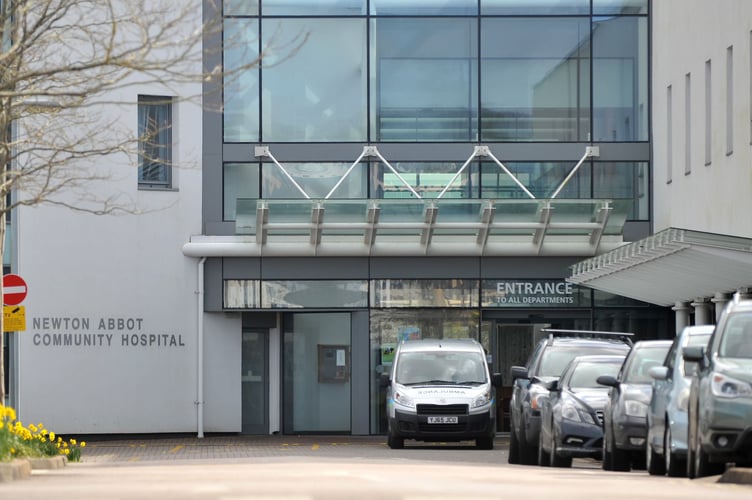
A 78-year-old woman died after having her oxygen supply switched off inadvertently at Newton Abbot Hospital, a coroner’s report reveals.
The coroner says having the supply switched off for an unknown period of time the day before she died ‘possibly caused or contributed to her death’.
The details are contained in an official Report to Prevent Future Deaths written by Devon, Plymouth and Torbay coroner Deborah Archer.
The Torbay and South Devon NHS Health Trust says it takes the coroner’s concerns seriously and is reviewing her report in detail.




“We are committed to learning from all incidents to improve patient safety,” said Chief Nurse Nicola McMinn.
The woman was taken to Torbay Hospital where she died on May 17 2022 as a result of bronchopneumonia, rib fractures and ‘respiratory distress’.
The coroner’s report says she had been living at a local care home and suffered from health anxiety, chronic obstructive pulmonary disease (COPD), asthma and heart disease. She was admitted to Torbay Hospital on April 16 2022 after a fall at her care home.
She was treated with low-level oxygen therapy because too much oxygen can cause issues for people with COPD. She was found to have a number of fractures and small blood clots.
Treatment was also given for other issues including duodenal ulcers.
On May 10 she was discharged to Newton Abbot Hospital and received a ‘minimal’ level of oxygen.
The report says she was ‘stable, eating, drinking and mobilising well’ and appeared to be improving sufficiently to begin the process of returning home, but on May 16 there was a note in the nursing records to say that her oxygen had been turned off.
The report goes on: “Asked about whether someone could have knocked the dial inadvertently the consensus was that it was not easily done – and certainly not easily done by a frail patient such as this.”
The patient’s oxygen levels then dropped sharply, and she was taken by ambulance to Torbay Hospital, where she died the following day.
The coroner lists four ‘matters of concern’, saying: “In my opinion there is a risk that future deaths could occur unless action is taken.”
Her concerns include a lack of training and understanding by staff at the trust that it is everybody’s responsibility to report and escalate a serious clinical incident such as this.
She adds: “There appears to be no effective process in place for reviewing clinical notes to pick up a clinical issue such as this in circumstances where no complaint has been made by a family member, and no member of staff has recognised or reported it.
“There appears to be a lack of understanding as to when a Serious Incident Report should be made or actioned retrospectively.”
She says there are also shortcomings in processes for reporting such incidents.
In a statement, Nicola McMinn said: “We extend our deepest sympathies to the family and friends of (the patient).
“We have received the Prevention of Future Deaths report from the coroner following the recent inquest. We take the coroner’s concerns very seriously and are currently reviewing the report in detail.
“We are committed to learning from all incidents to improve patient safety. We will provide a formal, comprehensive response to the coroner within the statutory 56-day period, outlining the actions we have taken since May 2022 and those we propose to take following the inquest.
“As this is a formal legal process, it would be inappropriate to comment further until our full response has been submitted to the coroner’s office.”
Comments
We've recently changed our login process. If you have an account for commenting, you will need to re-register on the login window.
This article has no comments yet. Be the first to leave a comment.