

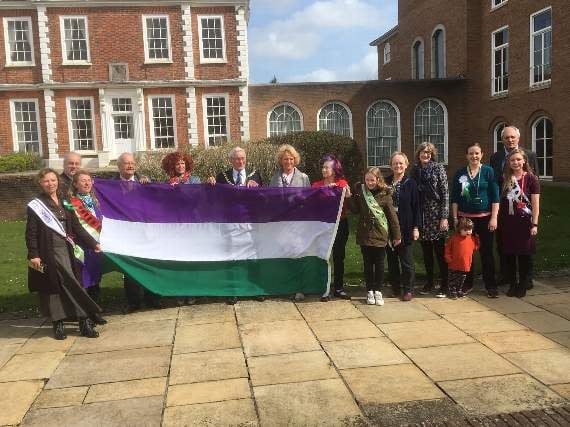
Equal rights for women across Teignbridge and Devon were celebrated at Devon County Council’s headquarters last week, April 6.
The council welcomed the suffrage flag to County Hall as part of the flag’s UK-wide relay celebrating 100 years since the first women gained the right to vote.
After hoisting the flag the council also held a celebration of the council’s first-ever female councillor, Juanita Maxwell Phillips, who was voted onto the council in 1931.
Cllr Ray Radford, chairman of the council, addressed the event.
.png?width=209&height=140&crop=209:145,smart&quality=75)



He said: ‘I welcome the suffrage flag to Devon County Council. The suffrage flag is on its way around the UK and in many ways it is symbolic that the flag should be on a journey, as achieving equality has been a journey, and in the present day, the call for equal rights has shifted to equal representation.’
Cllr John Hart, the leader of the council, added: ‘It is an honour for the council to have the flag as part of the relay and it is an acknowledgement of the input that women have had in the county over the years.’
Speaking to guests at the event, Lisa Berry-Waite, member of Fawcett Devon, said they were there to celebrate the centenary of the first women being able to vote. In February 1918 women aged over 30, who were occupiers of property or married to occupiers, were entitled to cast a vote.
She said ‘The suffrage flag is green, white and violet, which stood for giving women the vote. Green symbolised hope, white purity, and violet, dignity and loyalty.
‘But 100 years on we still don’t have gender equality and, for every battle won, there is a battle still to be fought. Events like this help us champion those before us who fought for gender equality and guide us going ahead into the future.’
A celebration of Devon County Council’s first-ever female councillor, Juanita Maxwell Phillips, also took place, and Dr Julia Neville provided a talk on her story.
Juanita campaigned on women’s employment as part of the Six Point Group and Open Door Council, and remained a member of the Women’s Freedom League until full equal suffrage was achieved.
After the First World War she embarked on a career in public life and was elected as a guardian, became the first woman borough councillor in Honiton and the first woman mayor, a role she held 11 times.
After losing a bid to be elected to the county council in 1928, she was successful three years later when, in 1931, she became the first female county councillor in Devon.
She fought for better conditions in welfare institutions; was a member of the Exeter and District branches of the National Union of Equal Citizenship Societies; and Women’s Welfare Association for women police and for access to family planning services. During the Second World War she was head of the Devon Women’s Voluntary Service.
As a councillor, Juanita worked to ensure good design in council houses, to acquire open spaces and playing fields and also challenged fellow guardians and county councillors over their out-dated assumptions on women’s employment and the role of health visitors.
She established the Women’s Institute in Honiton, where women could come together as well as develop new knowledge and skills, and also established the Devon Council of Women in public service.
As a councillor, guardian, magistrate and NHS board member she secured better housing, better support for mothers and children and for those in poverty, and better healthcare, and was awarded an OBE in 1950.
The suffrage flag, which has also been hosted by the Met Office, the Environment Agency, Exeter City Council, the University of Exeter and NHS Digital, now moves on to Plymouth.