

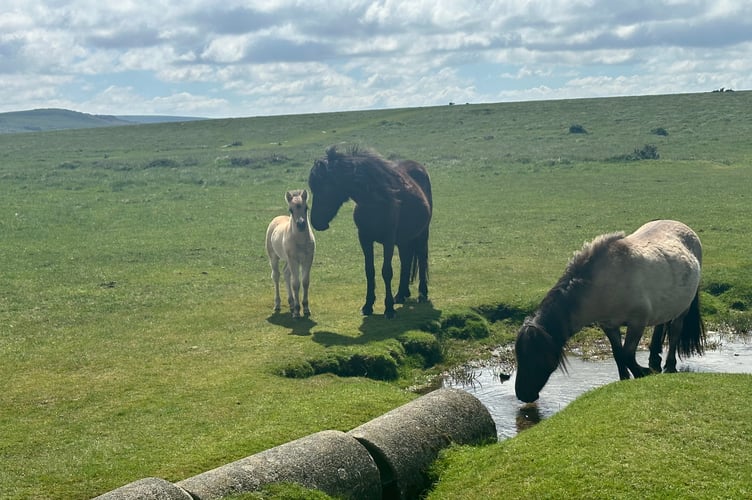
THE DARTMOOR Commoners' Council has been told to carry out a detailed assessment of whether the moor’s commons are overstocked with sheep, cattle and ponies.
The High Court has ordered the action following campaign group Wild Justice taking the Dartmoor Commoners' Council to the court over damage being caused to wildlife-rich sites within commons where farmers have rights to graze their animals.
The organisation said the council must ensure “Dartmoor is managed in a way that allows nature to recover".
Wild Justice, co-founded by naturalist and TV presenter Chris Packham, welcomed the verdict on Tuesday, March 17 which follows a court hearing last July.


That hearing saw the group's legal team argue that the Dartmoor Commoners' Council had failed to assess whether Dartmoor was becoming overstocked, contrary to section 4 of the Dartmoor Commons Act.
In a judgment handed down on March 17, Mr Justice Mould found: “Assessment of the number of animals that may properly be depastured on the commons at any given time necessarily implies both quantitative and qualitative analysis. The question for the defendant is whether stocking levels exceed the capacity of the commons properly to accommodate them. In order to address that question, among the matters which the defendant needs to interrogate are the numbers of livestock which commoners are entitled to depasture on the commons, the numbers that are actually depastured in reliance on rights of common, the areas of common in respect of which those rights are enjoyed and exercised, seasonal variations, and so on.”
Bob Elliot, CEO of Wild Justice, said: “This judgment shows that the Dartmoor Commoners’ Council failed to do the most basic of work needed in order to understand how many animals the Dartmoor Commons can sustain. When such an important landscape is already in very poor ecological condition, this simply isn’t good enough. The Dartmoor Commoners’ Council must now carry out the proper assessment required by law and ensure that Dartmoor is managed in a way that allows nature to recover. We will be scrutinising that assessment and, importantly, how DCC acts upon it in areas where overgrazing is apparent.”
The Dartmoor Commoners' Council said in a statement: "Wild Justice’s claim was centred on an argument that DCC had breached its statutory duties by failing to issue limitation notices which would have the effect of requiring commoners on Dartmoor to reduce the number of livestock depastured on Dartmoor's commons.
"Whilst the High Court rejected seven of Wild Justice’s eight grounds of claim, did not find that DCC had acted unlawfully by deciding not to issue limitation notices in recent years, and did not order DCC to issue any limitation notices or take any other action to limit livestock numbers, it did conclude that DCC must carry out a more detailed assessment of livestock numbers on the commons and their impact on Dartmoor’s natural environment.
"DCC accepts the court’s decision, welcomes the clarification of how it should carry out such assessments moving forwards and will do everything necessary to ensure that it complies with its statutory duties. DCC is in the process of arranging internal meetings of its members to begin the process of developing a robust methodology for the assessment in accordance with its statutory duties.
"DCC received significant support from the NFU’s Legal Assistance Scheme throughout the claim as the outcome had the potential to cause disruption to farming businesses on Dartmoor. The NFU has said it will continue to work closely with DCC and the NFU’s members in Dartmoor following the court’s decision."
The case follows a 2023 assessment of Dartmoor commons, the Fursdon Review, published by the government, which found that Dartmoor was “not in a good state” with many of the Sites of Special Scientific Interest (SSSI) on the commons in an unfavourable condition. Public body Natural England has identified reducing grazing stock numbers as a way to improve their environmental health.
Comments
We've recently changed our login process. If you have an account for commenting, you will need to re-register on the login window.
This article has no comments yet. Be the first to leave a comment.