

Twenty-year-old Maisie Bull is living a life most of us can’t imagine. Constant, agonising pain is something she has to endure every day, with no prospect of a cure, or even a pill that would give some temporary relief.
The unrelenting pain is in her right foot, so it hurts to walk, drive or even stand still on the spot. Everyday routine actions are a gruelling endurance test.
But as if this isn’t enough of an exhausting, demoralising battle, Maisie, from Newton Abbot, is also struggling to get her suffering taken seriously by the medical profession.
She said: “I feel like I’ve spent most of my life fighting to be heard. For years I’ve been passed from service to service, without ever feeling like there’s a clear plan.”
Maisie’s condition is called Complex Regional Pain Syndrome (CRPS), and it’s so rare that it isn’t widely known or understood. It can develop after an injury or operation and causes the nerves in the affected area to keep sending strong pain messages to the brain.
Maisie developed it after surgery that was supposed to cure a constant pain in her foot that she’d suffered since the age of six, which was diagnosed at the time as a bunion. The long-awaited operation didn’t solve the problem – it made it worse. She still has the original pain, plus the CRPS.
And doctors keep telling her there’s nothing they can do for her.
She said: “My GP tells me my condition is too specialist.
“When the pain becomes unbearable, I’m advised to go to A&E – but after waiting for hours, I’m told there’s nothing they can do, and I’m sent home, still in agony..

“It feels like an endless cycle.”
In desperation, she’s even asked doctors whether her foot could be amputated: “I’d rather deal with the consequences of that than with the pain I’ve got now without any help. At least then it wouldn’t be an invisible disability, and I could have prosthetics and all the other support they can give you.”
Maisie wants to highlight what she describes as a ‘massive gap in care’ for people with her condition, which is exacerbated by the difficulty in getting medical professionals to listen to her. Even though she’s an adult, she says she’s ‘treated like a child’.
“My dad’s coming to all my appointments with me just to get the point across, because it seems that without an older person there, they don’t care.
“But all they do is say ‘let’s up your dose of anti-depressants’. They want to treat the consequences, not the cause.
“It feels like I’m under the radar, pushed under the carpet, because people think ‘she’s 20, she’s active, she can cope with it’ – whereas actually I’ve had my life stripped away from me, bit by bit.
“This isn’t how 20 looks for anyone, let alone how I wanted it to look for me.”
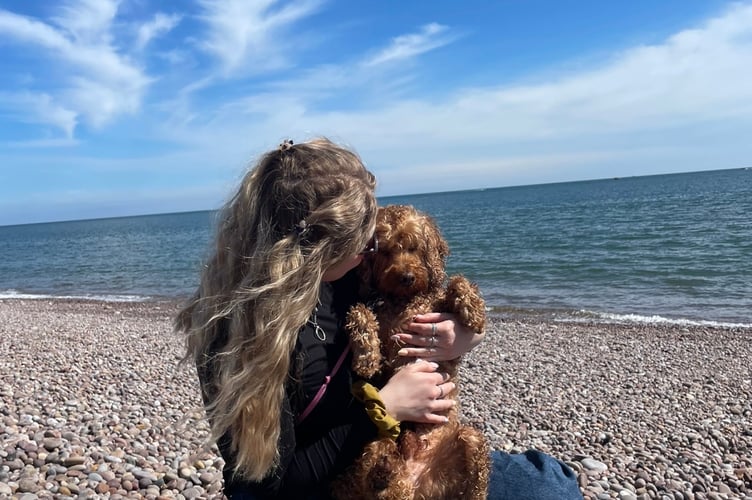
Yet to an outsider, many aspects of Maisie’s life would look …. normal. She works full-time in the office of a boat engineering company, and volunteers at a dog rescue centre on Saturdays. When she’s able to, she loves taking her own dog, Basil, to the beach, even though walking for any distance with him is impossible.
“Just to sit on the beach, throw his ball, see him have fun like a puppy again even though he’s 11. It’s the little things that get you through the week and that’s what you’ve got to do.”
“People see me go to work and assume I am managing, but they don’t see what happens behind closed doors. They don’t see the exhaustion that comes from constantly battling severe pain while trying to live a normal life.
“Something as simple as washing my hair is exhausting – I have to sit down in the shower because standing for that long is too painful.
“Whenever I leave the house I have to plan everything in advance: where I can park, where the nearest benches are, how far I will have to walk.”
“There’s a huge difference between living with pain for a few weeks or months and living with it for nearly your entire life. I don’t know what it feels like to be pain free.”
There is a support group for CRPS sufferers, called Burning Nights. As well as offering advice for people living with the condition, and helping them connect with each other, it provides information on clinical trials and research studies they could take part in, all over the world. Maisie says she’s applied to take part in ‘everything they offer’, and is willing to try anything that would offer even a small chance of improvement.
She no longer dreams about a complete cure for her condition – just something that would enable her to do a few of the things most of us take for granted.
“I dream about enjoying a day out without constantly calculating how far I am from the car, whether I can make it back, or how much I’m going to suffer afterwards.
“To many people, that probably sounds like a very small thing. To me it would mean everything.
“I am not ready to believe that there’s nothing left to try, I’m not ready to stop fighting for answers. I am simply asking for the opportunity to explore every possible option before beng told to accept a lifetime of pain. I’m not ready to accept that a person of my age should simply learn to live with it without further support, investigation or hope.
“That is why I am sharing my story,
“I want people to understand that chronic pain is real, and that invisible illnesses can completely change a person’s life. Most importantly, I want other people who are fighting similar battles to know they are not alone.
“I am still fighting for answers, I am still fighting to be heard.
“And I’m still holding on to the hope that one day I will be able to do something as simple, and as meaningful, as walking my dog without pain.”
Comments
We've recently changed our login process. If you have an account for commenting, you will need to re-register on the login window.
This article has no comments yet. Be the first to leave a comment.