

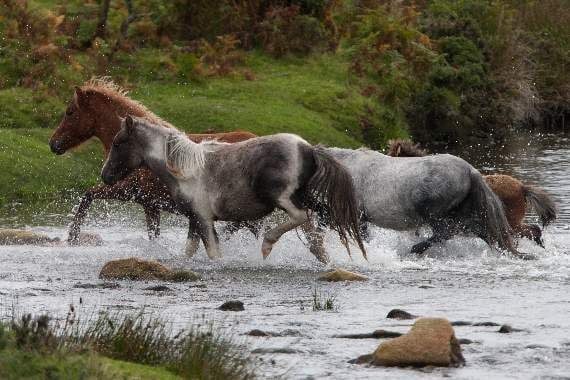
THIS is the time of year when much-loved Dartmoor Hill ponies are served up at farmers’ markets...as burgers and sausages.
Some people have been disturbed to find the popular species being sold as an unusual delicacy at such events.
Farmer Charlotte Faulkner, who set up the Dartmoor Hill Pony Association and came up with the idea, has defended the scheme.
Hundreds of ‘excess’ ponies are culled each year to keep a constant number in the national park - with meat being sent abroad for human consumption or fed to other animals.




Charlotte, 55, at a stall with fellow Dartmoor farmer Mary Allford at the Tavistock Farmers’ Market on Saturday, revealed that despite the controversy the meat had proved popular.
It is regularly available at the twice-monthly market, and it can also be bought online or at three local pubs.
Charlotte said the idea was to create a meat market for the older ponies to stop the foals being shot at birth.
She insisted she was only returning to old time practices when surplus ponies would be sold for meat locally.
‘People travel to us to buy pony meat and we even have return customers. They seem to be surprised to see pony meat - but they do understand what we are doing,’ she insisted.
She added: ‘The pony meat is high in protein and low in fat - everything we look for in food. It is also important to say that we will never breed ponies for meat.’
The pony meat stall is run by Dartmoor Conservation Meat, a co-operative of a variety of organisations.
It is one part of a pony herd management plan which includes selling ponies to be trained and domesticated to become riding or driving ponies. Mare contraception is used to match the number of foals born to the number of ponies sold.
Farmers are being encouraged to look for new ways of increasing pony value and avoid culling of ones under a year old.
Charlotte says that selling their meat and training them to become riding and driving ponies are ways in which farmers can justify keeping them.
And creating a small meat market for animals not wanted for leisure puts a higher price on all the ponies’ heads. It mean farmers can also fetch more for those sold as riding horses.
Charlotte said: ‘The size of pony herds kept on Dartmoor is recommended by Natural England, the government’s guardians of Dartmoor’s biodiversity.
‘These recommendations must be kept. Up to 750 foals will be born each year and 300 foals will be homed, with difficulty, to become future riding, driving or companion ponies - or to join conservation grazing herds.
‘Fifty foals go back on to the moor with the herds which leaves an excess of 400 foals which are shot. This is not acceptable.
‘Three-year-old ponies have more value to buyers than foals as they are the correct age to train.
‘A farmer, knowing that there is a meat trade as a fall-back, is more confident keeping a pony until that age so the chance of a foal growing and being trained for life is improved.’
Comments
This article has no comments yet. Be the first to leave a comment.