
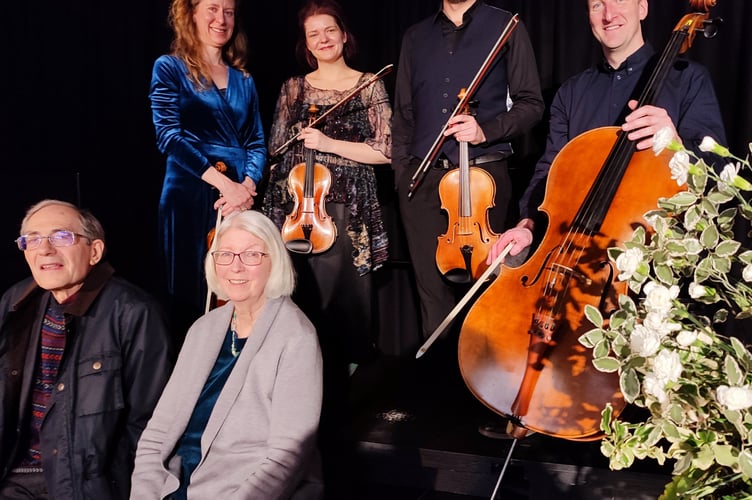
A near capacity audience, ranging in ages from 6 to 96, had a tingle-factor afternoon at the hands of the Heath String Quartet, writes Jeff Collman.
Players at the best venues in London, Berlin and the USA, the Heath had raised our expectations high for their NADSA concert at Newton Abbot’s Courtenay Centre last Sunday (January 18).
Right from the first few bars of the Schumann’s Allegro vivace, we had lovely interplay between the instruments with excellent tonality and tight contrasting dynamics. The Andante was an interesting walk, its recurring melody returning fresh each time, with occasional adept use of rubato. The final two movements progressed from fast fun to lively virtuosity, moving my thoughts from comfort zone to admiration.
Sarah Wolstenholme spoke to us about the Polish composer Grazyna Bacewicz: her compositions prioritised things that make players feel good, testing their limits, and she used every technique she could think of. We became immersed in a display of sonorism: a leap into a different world of experience where sonics are unfettered by conventional tonal melodic lines.

But was it music? Somehow, the Heath gave cohesion to a highly unusual collection of sounds, giving it the legitimacy of musical form. Yes, that was music! Bravo to the Heath for placing themselves near the edge of technical vulnerability, and for challenging our musical complacency.
After the interval, Sarah spoke about the Matthew Locke [1621-1677] works, originally written for viols. Now, played on modern instruments, techniques of bowing and tonality have to be pared back, and the focus of the music is very much on the composition. Immediately, with the lack of vibrato in the Fantasia of Locke’s Suite No 3, we had delicacy of interweaving melodic lines, followed by contrasting dynamics.
There was no doubt that his Courante and Sarabande were dances, but with courtly restraint and attention to the precision of that bygone era.
During the first movement of Beethoven’s Quartet No 16, I noticed how integral the pauses were: as if the audience was being invited to participate. The Vivace provided a different dimension of lively emotion, but both movements felt a setting of the scene for the Lento. Here we had a legato line with superb restraint and varying dynamics that, without sentimentality, touched the soul.
The pauses were moments for the audience to relish. This was musical drama of the highest form – even Wagner might have been impressed! Stunning. The final movement is very much a question – ‘Must it be?’ – and answer – ‘It must be!’ – session. In the Heath’s rendition, the gravity of the question was there for all to witness. The final few phrases, preceding some pizzicato, left us still aware of the questions, but with quiet acceptance.
This concert was not only a credit to the Heath String Quartet’s performance; it also provided a kaleidoscope of musical styles and their techniques. A programme containing mostly lesser-known works is unusual; we don’t have to go to London for inspiration – it’s here.
Comments
We've recently changed our login process. If you have an account for commenting, you will need to re-register on the login window.
This article has no comments yet. Be the first to leave a comment.