

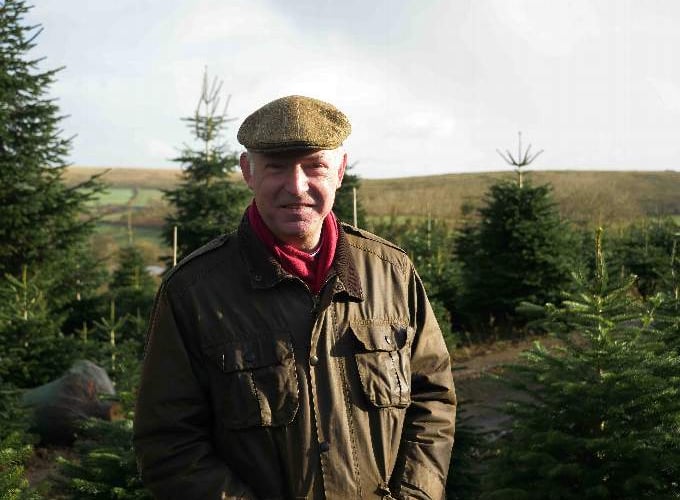
A Christmas Message from the Bishop of Exeter, The Right Reverend Robert Atwell
I LOVE Christmas trees. I was recently fortunate enough to visit Dartmoor Christmas Tree farm, near Widecombe. It was amazing seeing so many trees growing in spectacular surroundings. It was a big contrast to Romford Market in Essex where my dad used to take me and my sister to choose our Christmas tree when I was growing up.
Christmas trees are a real focal point in the home, whether it’s one you have spent time choosing from a farm or market, one you have carefully kept alive all year in a pot in the back garden, or one you pack away each year in the loft, ready for next December.
Legend has it that Devon’s patron saint, Saint Boniface, was responsible for the first Christmas tree. He was born in Crediton in the 8th century and introduced Christianity to Germany.



It is said that, in old age, Boniface came across a group of pagans gathered around an oak tree about to sacrifice a child to the god Thor. To stop them and save the child’s life, Boniface felled the tree with an axe. So angry were the mob that they turned on Boniface and killed him instead.
But that was not the end of the story. It is said that where the oak tree had stood a small fir tree began to grow up. People saw in its evergreen leaves a symbol of God’s unfailing love for us in Jesus Christ.
Whether or not the legend is true, Christmas trees became symbolic of Christianity in Germany and when in the 19th century Prince Albert married Queen Victoria, he introduced the custom to England, and they are now an indispensable part of our Christmas festivities. There is a real wow moment when you step back from your newly decorated tree and switch the lights on.
For some, Christmas becomes real when you hear the mellow tones of a Salvation Army band playing carols as you do your Christmas shopping, catch the gingerbread scent of Christmas baking, or collapse in front of telly to watch It’s A Wonderful Life for the umpteenth time. For others, it’s giving and receiving hospitality or going to a candle-lit carol service.
Whatever lies at the heart of your Christmas, for all of us once again it is tinged with uncertainty. The pandemic seems to be resurging. The omicron variant is rife, cases are rising rapidly, and thousands of people will now be self-isolating rather than spending it with friends and family. It is about as far removed from a ‘merry’ Christmas as you can get.
As a result, some people are understandably anxious or low. Life feels pretty bleak. But without denying the painful reality of the situation, we can choose whether or not to allow it to define us.
Because what doesn’t change is the reality and meaning of Christ’s birth: Emmanuel: God with us. God is with us in the dark times not just the happy times. God is with us in times of illness, loss and disappointment, as well as in times of celebration and joy.
At Christmas we often read the opening of St John’s Gospel and hear the words: ‘The light shines in the darkness and the darkness did not overcome it.’ Those words bring me hope this Christmas.
I believe that God’s living heart beats in the child Jesus, lying in the manger. In this birth we encounter the extravagant, self-giving love of God. Which is why for me at the heart of Christmas is thankfulness: thankfulness that ‘God so loved the world that he gave his only Son, so that everyone who believes in him may not perish but have eternal life’ (John 3:16).
Thankfulness makes us bigger people. Thankfulness stops our hearts going rusty.
At the end of the film A Muppet Christmas Carol, the funny but rather bizarre Hollywood remake of Charles Dickens’ novel, the central character, Ebenezer Scrooge, played by the actor Michael Caine, sums up what lies at the heart of Christmas in a song, ‘A Thankful Heart’.
He sings, ‘Every night will end, and every day will start, with a grateful prayer and a thankful heart…. Stop and look around you. The glory that you see is born again each day. Don’t let it slip away, how precious life can be.’
Life is indeed immensely precious. Which is why I pray that, as we look at our Christmas trees, there will be moments for each of us to stop and reflect, time to look beyond ourselves and be thankful – thankful for the gift of life, thankful for family and friends (whether or not we are able to be together) and above all, thankful to God for his love revealed in this child of Bethlehem.
Comments
This article has no comments yet. Be the first to leave a comment.