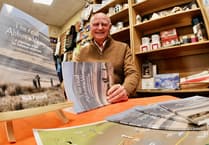
NEWTON Abbot's long love affair with the salt cod industry, which brought wealth and adventure to many in the south west, is being celebrated in a new exhibition at the Newton Abbot Town and GWR Museum. This is the story of how thousands of men and women made the annual 2,000-mile migration, often in small ships, to the rich fishing grounds off Newfoundland. For many it was lucrative seasonal work. Others stayed behind and helped build up St John's – Newfoundland's capital. Family histories unearthed during research have shown the movement of families to and fro, the bleak stretch of the Atlantic made smaller by frequent crossing. Businesses in Newton Abbot thrived, providing such necessities as rope, fish hooks, victuals and sailors' leggings. The human migration followed the cycles of the cod, with men gathering in large numbers every spring at the Newfoundland Arms, East Street, and other pubs and hotels before sailing from Newton Quay and elsewhere. The colonisation of Newfoundland also formed an important chapter in the Britain's imperial history – a fact recognised by Winston Churchill in his book A History of the English Speaking Peoples. A licence to explore overseas was granted to local explorer Sir Humphrey Gilbert, by Queen Elizabeth I. The patent charged him 'to search, find out and view such remote, heathen and barbarous lands, countries and territories not actually possessed of any Christian prince or people and the same to have, hold, occupy and enjoy to him, his heirs and assigns for ever.' Sir Humphrey, a half-brother of Sir Walter Raleigh, took possession of Newfoundland, thereby establishing England's overseas Empire. To their bemusement, this was 'witnessed by divers (sic) Spaniards, Portugals and other strangers', in August 1583, only to drown on the return trip. Sir Humphrey's descendant, Geoffrey Gilbert, of Compton Castle, Marldon, opened the exhibition on Monday. He told the audience of his visit to Newfoundland some 20 years ago where he met a Mr Dawes, whose family emigrated from Paignton in the 1600s and heard to his amazement the Devon accent still alive and well. Appeals put out by the museum for information from locals with Newfoundland links bore fruit, with offers of photographs and other memorabilia. Of great interest is the Winser family tree, researched by distant relative Leslie Webber, of Shobbrook Hill, Newton Abbot. Dating back to 1610, it is peppered with the names of those who died in Aquaforte, Newfoundland, several of them sea captains – one, incidentally, with the name Peppery Pete! Curator Felicity Cole is hoping that the exhibition will prompt more people with seafaring ancestors to delve into their past with help on offer from genealogists in Newfoundland. There is a noticeboard where people can scribble down their details. The exhibition continues until the end of September. At the opening, the mayor, Cllr Daphne Watts, presented Mrs Cole with an accreditation certificate from the National Museums and Libraries. She told this newspaper afterwards: 'It means that this museum has reached a certain standard. It's all down to the curator and her volunteers. The town council is proud of the museum and quite rightly so.' Mrs Cole paid tribute to the museum's volunteers and said: 'It is an encouragement for us to carry on raising our standards and is a sense of achievement for us all. It's lovely.'