
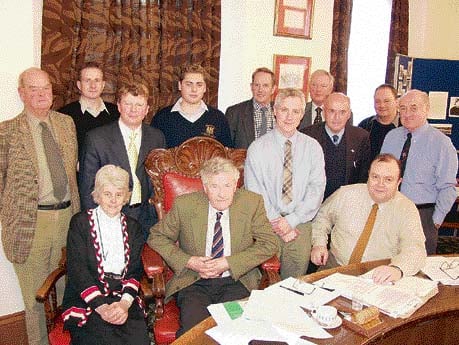
A NEWLY formed high powered campaign group is fighting to save Newton Abbot's Seale-Hayne College.
Chaired by Truro farmer, Jim Hosking, a former Seale-Hayne governor, it is formulating a solid case in an effort to convince the vice-chancellor of the University of Plymouth, Prof Roland Levinsky, to keep it open.
Mr Hosking speaking after the Seale-Hayne Futures Group met in Newton Abbot Town Hall, on Friday, made it clear that members were adamant that Seale-Hayne had an important part to play in the university's future.
'We believe if it was properly expanded and, developed on its present core structure, it would give enormous opportunities to progress the vice-chancellor's quest of excellence for the University of Plymouth.



'We have representatives of a very powerful group here and have not been able to express more than fragmented opinions.
'The university is still to develop and cost its plans and until those are debated we still have a chance to develop the college,' said Mr Hosking.
Other members of the group included Teignbridge MP, Richard Younger-Ross who maintained the university's reasons for wanting to close Seale-Hayne were academically and economically flawed.
'The college should be developed and expanded,' he said.
Teignbridge and Devon County councillor Stuart Barker said the vice-chancellor had made some very important points and he emphasised the group was not trying to undermine them.
'We want to show there is a better way that Seale-Hayne, maintained, developed and expanded, has a tremendous opportunity to meet the vice-chancellor's ideals,' he said.
Adding his support, Teignbridge and Newton Abbot town councillor Roger Mewis, said the retention of Seale-Hayne was important both for agricultural education and the economy of Newton Abbot.
The group has drawn up a series of points to try to convince the vice-chancellor to keep the campus open.
It believes there is a need for a land-based university level institution in the south west and that the unique nature of Seale-Hayne makes it an ideal base for such activities.
The group's primary aim is to expand teaching and research at the site.
It says:
1 Undergraduate teaching is fundamental to this.
2 Seale-Hayne meets the needs of the rural economy in the south west for both suitably qualified graduates moving into the rural economy and for research and consultancy.
3 Seale-Hayne should encompass other land-based activities in a centre of rural excellence.
4 The group wants to maintain and enhance the reputation and name of Seale-Hayne in the land-based areas for which it is universally recognised.
Others in the group include John Halley, the former vice-principal of Seale-Hayne; Prof John McInerney the former director of Exeter University Agricultural Economics Unit; Dr Eirene Williams, a lecturer at Seale-Hayne; Ian Goodwin, a former governor; James Lewis, the president of the students union; Luke Telford, the vice president; Devon County councillors Fred Symons and John Glanville, and the president of Newton Abbot Chamber of Trade David Ridgway.
The university announced in November it was intending to close Seale-Hayne in August 2004, but gave only until December 13 for representations to be made to the governors.
Despite protests that the consultation period was too short, the governors ignored the pleas for an extension and went ahead with their decision.