
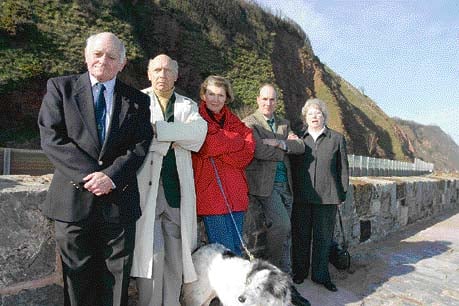
RAILWAY bosses have defended the controversial cliff netting and 'eyesore' rock fences, designed to protect the railway line between Teignmouth and Dawlish from landslips and rock falls.
Critics say that residents and local councillors were not consulted about the £6.3 million scheme. They argue that the protective netting will interfere with wildlife, and that the rock fences are an ugly intrusion into a world-famous stretch of coastline.
Last week, Teignbridge MP Richard Younger-Ross hit out in Parliament at the loophole in the planning law that allowed Network Rail and its contractors to do the work under a permitted development order, without the need to consult or obtain local authority approval.
But Chris Arnold, Network Rail's project manager, said that the not-for-dividend company had made submissions to Teignbridge Council in August 2002.


'We have done an environmental audit on the wildlife and fauna of the cliffs, and that was submitted to Teignbridge, but our offer of a meeting was not taken up,' he said. 'There have always been big problems with the cliffs, right from the time the railway was built in the 19th century.
'In some ways we can't win, because doing nothing is not an option.'
Andy Boakes-Stapleton, of contractors Dean & Dyball, said that the company was proud of its ISO14001 environmental accreditation, 'which are not handed out lightly'.
He said that the rock fences, 'as a construction and design', achieved everything they wanted.
'Aesthetically, I accept people's criticisms, but I think that we were constrained by the design requirements,' he said. 'The project had to be value for money, and fence repainting schemes are too expensive.
'We have to think about continuing maintenance in a harsh marine environment, and budgets might not always be available.'
He added that there were safety issues of working alongside an operational railway line, and frequent night shifts.
Michael Woods, Network Rail's environmental consultant, said that most gulls were not cliff nesters but tended to nest in colonies on the ground.
Mr Woods said: 'Consequently the impact of the netting on the nesting habits of the gulls here should be negligible. Furthermore, the netting will not cover the entire cliff face, and if gulls are looking for nesting sites on the cliff then there should still be areas available to them.'
He added that the vegetation should re-grow to approximately its present state between three and five years from now. The plants on the cliff sides would suffer marginal impacts as a result of the meshing works and should recover quickly once they were complete.
'It is difficult to see how these works will favour one species over another and allow the stronger to out compete the weaker and so it is likely that the same communities should continue,' he said. 'Unless weather conditions are extremely unfavourable, the shrubs currently being cut down will readily re-grow.'