
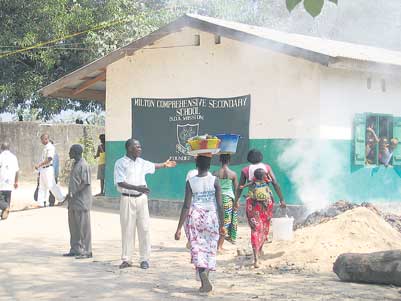
On Wednesday we left Freetown for Bo, Sierra Leone's second city, in the central southern part of the country.
First we had to get petrol. The car's owner had supplied it nearly empty.
Petrol station after petrol station turned us away – no petrol. With relief Kojo, our driver, pulled into one that was open. A uniformed attendant filled the car and we set off.
A couple of miles later, Kojo declared 'they've cheated us.' The fuel indicator was barely above empty.
'They cheat us all the time,' Rosa said.
Kojo said he knew the owner and would sort it out. We decided to push on and deal with it later.
I wondered if the journey to Bo would be a repetition of our trip to Farafenni in The Gambia in 2006: a bone-shaking three hours on dirt roads, leaving you caked in dust, head buzzing.
In fact the road was good, 'better than many roads in Devon,' we joked with Kojo, a civil engineer who, like many, cannot get a job in his chosen profession.
The speedometer hovered at 80-90mph much of the way, slowing to 60mph as we roared through villages, Kojo's hand pressed firmly on the horn warning pedestrians, motorcyclists and cars to get out of the way.
There doesn't seem to be any speed limits in Sierra Leone. Dogs like to sleep in the roads here. So do sheep. In one village we gave one a glancing blow. It ran off to live another day. In another, the van in front suddenly veered crazily, only then could we see a toddler in the middle of the road, pulling a toy car. Kojo stamped on the brakes and we stopped with feet to spare. Distraught faces appeared from all sides and a young woman ran forward and pulled the infant to safety.
Outside Bo, we were stopped at a police checkpoint. 'Overloaded,' shouted the policeman in charge. He was right, although we were not as heavily laden as some vehicles we had passed. Kojo was the only one with a seat to himself. In the front passenger seat Janet McLellan was perched on her husband's knee. In the back, four of us were squeezed into seats designed for two. The boot was jammed with suitcases and gifts for the schools we were visiting.
Money was bound to be involved and we waited apprehensively as Rosa set about him in Krio, a mixture of English and native dialects which is the lingua franca here. We were soon waved on our way.
'What did you say?' we asked.
'I told him that I am a missionary and these are my English friends and that you have to come to look at schools in Bo.'
But before we could set foot on any campus, there were the courtesies to attend to. We stopped off at Bo City Council to meet city mayor Dr Wusu Sannoh. He welcomed us warmly and was frank about the challenges facing education.
Dr Sannoh said they could double the number of school places and still not have enough.
'Every class is so full you wonder if they can learn anything at all. It means that our school performance in the public exams is compromised,' he said.
He reckons it will take a decade to sort out. Meanwhile, those children who missed out on schooling because of the war are now adults and need different kinds of help.
Later we called on Prince Lappia Boima, the newly-elected paramount chief. He received us in his outdoor audience chamber. As formalities were exchanged, a small chicken pecked at the dust. A handful of petitioners waited patiently in the outside.
An impressive man with a sense of humour, the prince was formerly a maths and physics teacher and an examiner in physics. Most recently he worked as logistics coordinator for the mining company, Sierra Rutile.
'The developed nation is an educated one. I think, had we had education in Sierra Leone, we would not have had the rebels. We would not have been fooled by them. You will find lots of lapses in our system. I think your visit will inject some spirit and pray it will.'
SEE LINDSEY SILL'S FULL REPORT AND MORE PICTURES IN OUR ONLINE EDITION
Comments
This article has no comments yet. Be the first to leave a comment.