
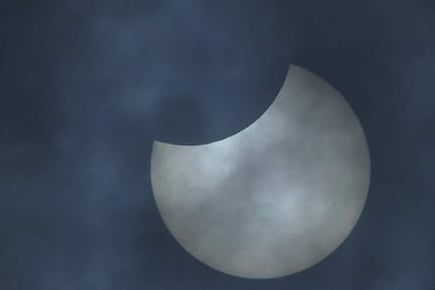
The RNIB’s eye health team has offered advice the safe viewing of the partial solar eclipse on later this evening (Wednesday, August 12).
This will be the most significant eclipse event seen in the UK since the 1999 solar eclipse, which was total from parts of South West England.
The partial solar eclipse will be visible across Devon with about 95% of the sun covered by the moon at 7.13pm
Experts say watchers should not look directly at the Sun without protection or you risk seriously damaging your eyes.
Poonam Patel, Eye Health Information Service Manager for the RNIB (Royal National Institute of Blind People) has shared the following tips to make sure you protect your eyes while observing this rare event.
- Never look directly at the sun during an eclipse with the naked eye, sunglasses, a camera, binoculars or a telescope, as this can cause permanent retinal damage. Special solar filters designed for eclipse viewing are required.
- Looking directly at the sun during an eclipse can cause solar retinopathy, a type of retinal injury that may lead to permanent blind spots, distorted vision or reduced central vision.
- Retinal damage is painless and symptoms may not appear immediately. Anyone who notices changes in their vision after viewing an eclipse should seek prompt assessment from an optometrist or eye care professional.

.jpeg?width=209&height=140&crop=209:145,smart&quality=75)
- Only eclipse viewers that comply with the international safety standard ISO 12312-2 should be used for direct viewing of a solar eclipse. Glasses should be checked for scratches, tears or other damage before use and discarded if damaged. Reusing old eclipse glasses should be done with extreme caution in case damage to the lenses has compromised their filtering properties.
- Never use eclipse glasses together with binoculars, telescopes or cameras unless the equipment itself has a properly fitted solar filter designed for that device.
- The reduced brightness during an eclipse can make it feel more comfortable to look at the sun, meaning people may look for longer and expose their eyes to harmful levels of solar radiation.
- Cloudy conditions do not make it safe to look directly at the sun.
- Ordinary sunglasses, no matter how dark, do not provide sufficient protection. Wearing multiple pairs of sunglasses does not mitigate the risk.
- The safest ways to observe an eclipse are indirect methods, such as projecting the image through a pinhole or using a colander to cast the sun's image onto a surface. DO NOT look directly at the sun through the pinhole or colander.
- Children should be supervised when viewing an eclipse.
The Royal Observatory Greenwich will also be live-streaming the partial solar eclipse from 6.10pm tonight and has more information about when and where to see the eclipse on its website www.rmg.co.uk/royal-observatory.
Comments
This article has no comments yet. Be the first to leave a comment.