
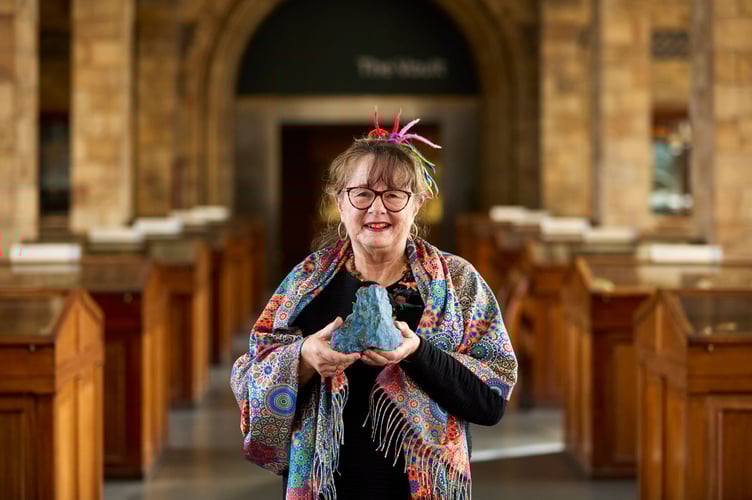
A mysterious blue mineral, first analysed by experts at London’s Natural History Museum back in 1996, is now on public display in the museum’s Minerals Gallery.
When first brought to the museum 30 years ago by broadcaster and Teignmouth-based artist Anna Grayson, experts were unable to identify the mineral and suspected that it was new to science.
Anna bought the mineral in 1980 from a roadside stall along a road south of Fez, Morocco. The stall’s trader thought the rock to be lapis lazuli.
A geologist herself and noticing its electric blue hue, different to that of lapis lazuli, she brought the mineral to the museum in 1995, as it was holding an open day for people to bring in specimens for identification. Given its complex characteristics, a team of experts, led by the esteemed late mineralogist Dr. Gordon Cressey, spent more than a year analysing the specimen.
Anna said: ‘When I first saw the mineral on that roadside stall in Morocco, the first thing I noticed was that specific shade of blue. Secondly, the "faces" are at an angle and look as if they have been polished with a sheet of rough sandpaper.
‘This property is known as slickensides and is formed by movement in faults. In a sense it is like fossil earthquakes, recording a tectonically active high-pressure environment.’
It was not until much later that experts described it as aerinite, a rare and complex carbonate-bearing silicate. During the sample’s first analysis, it was thought to be a mixture of different minerals and at the time aerinite did not have an entry on the International X-ray Diffraction Database - one of the reasons why the museum first considered that it may be new to science.
Dr. Paul Schofield, Principal Researcher and a member of the team who went on to study the mineral’s properties at the Natural History Museum, said: “It’s fantastic to see this ‘blue mineral’ sample back at the museum, it created such excitement when Anna brought it in during National Science Week.
“Working with Gordon to measure and understand the unique properties of aerinite took us to many different laboratories around the country. It was such an exciting time, a journey of scientific discovery.”
Aerinite (meaning ‘blue sky’ in Greek) was first named in 1876, however the complex nature of the mineral meant that its structure was not officially determined until 2004 by a team of researchers in Spain.



The largest mineral of its type to be analysed by the museum’s team, the analysis of this specimen subsequently allowed experts to realise that other unnamed mineral specimens in its collection could also be classified as aerinite.
Anna continued: ‘The Natural History Museum has been an important part of my life since I was seven years old and Gordon Cressey was one of the most impressive scientists I have ever met.
‘I am so proud the specimen is to be on permanent display. Mineralogy is a science full of beauty and wonder, the foundation for materials science and our modern world. This mineral has more stories to reveal, I am certain, as do all the other wonders of the planet displayed at the Natural History Museum.’
Comments
We've recently changed our login process. If you have an account for commenting, you will need to re-register on the login window.
This article has no comments yet. Be the first to leave a comment.