

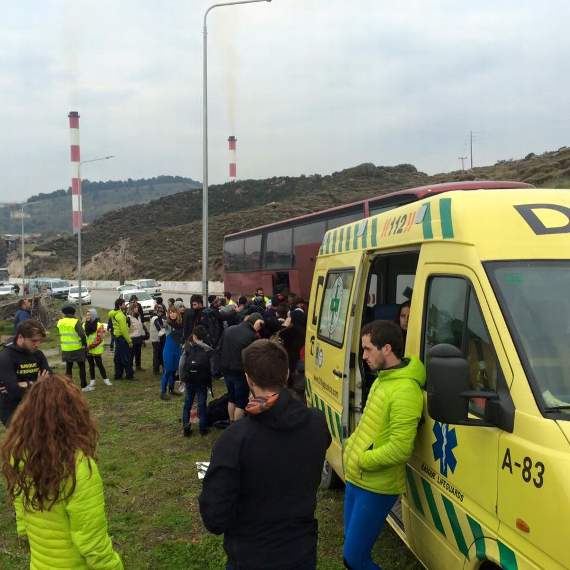
A FORMER Newton Abbot woman and her son have travelled to the Greek island of Lesbos to help the influx of refugees fleeing Syria.
Cheryl Turner-Hunt, 52, and her son Josh, 22 (circled right), are among the volunteers literally providing tea and support to those who survive the journey.
They are working at the Olive Grove Tea Tent which gives hot drinks and food to refugees at the Olive Grove camp which has been set up at the registration centre at Moria.
Cheryl, who now lives in Spain, has been in touch with mum Marlene Turner, who lives in Newton Abbot, keeping her updated with their experiences.

Marlene told this newspaper: ‘Cheryl loves helping people. She went out in January and is staying at least another month.
‘It is so sad what she is saying about what is happening there.’
One of Marlene’s own hand-knitted jumpers has been used to help one man Cheryl found dripping wet.
In a harrowing and moving account of her experiences, Cheryl explained that most of the refugees landing in Lesbos are women and small children, often travelling alone.
She said: ‘The stories we hear first-hand are of bombed towns, loss of family members and their homes, injuries we see from torture, enslaved women, no education for the children and an utter lack of resources.
‘This is not to mention the horror once they reach Turkey, where they are literally in the hands of brutal mafia.
‘Left exposed in freezing, hidden camps on hillsides, they often have their money and valuables stolen until they are beaten with iron bars to make them get on boats and force them to get rid of their ID, sometimes at gunpoint or knifepoint and herded on to flimsy plastic boats and pointed in the direction of Greece.
‘The dingy has only one pilot who is unskilled in navigation and often chosen at the last minute.’
So far this year, 400 people have died trying to cross from Turkey to Greece.
Cheryl explained that the Turks do not want to make the journey themselves as they can face 20 years in a Greek jail for people-trafficking but if the boat is valuable and worth returning, a young Turk is forced to take the boat, often throwing the refugees out into the water before the shore so they can turn back before being caught.
Boats often fill up with water so the refugees have to bail out using water bottles.
Life jackets are dangerous as the foam soaks up water and weighs the refugees down.
Even if they survive the journey, they arrive soaked and freezing from the wind and water and wading ashore.
Their rucksacks with few possessions are also soaked through.
Cheryl, Josh and other volunteers are able to help them get dry, give them a hot cup of tea and some food, dry nappies for babies while they wait for United Nations buses to pick them up to take them to the camp for registration.
At the Olive Grove, they can get hot drinks 24 hours a day, a constant supply of snacks and fresh fruit and clean, dry clothes.
Shoes and socks are most important followed by waterproof padded jackets, hats and gloves, jumpers, leggings and tracksuits.
If there is an influx of boats, the volunteers can be faced with finding clothes for up to 400 people in a short space of time.
Cheryl described helping a young boy aged about 13 who was frozen, finding him clean, dry clothes and meeting a young family with a single mum and a baby no more than a few days old.
When attempting to help a group of men, an alert on social media led to thousands of men’s boots arriving at the camp.
The official Moria compound is a former prison but has solid accommodation and is staffed by officials from non-governmental organisations including Save the Children and Médecins Sans Frontières.
The Olive Grove itself has dozens of tents where the overflow of refugees waiting to be registered can sleep and has a medical team, nurses, translators, hot water, a marquee as well as a clothing distribution tent, storerooms and offices and the tea tent where Cheryl works.
It is open between 18 and 24 hours a day and volunteers work in shifts.
Cheryl wrote about heading for work one morning when a large, wooden boat had pulled up on a headland.
She said: ‘One man was absolutely dripping wet so I found one of my dear jumpers in the case, hand-knitted by my mum and it was the best I could do.
‘We laughed as he understood my mum had knitted it, it was a lovely moment.’
The group has set up a fundraising page to help support its work at www.chuffed.org/project/tea-tent-moria.
Cheryl said: ‘The tent is like a beacon of love and warmth, we give out hugs and smiles with tea and food, we deal with volunteers in tears and shock from stories they hear, we feed people and send them back out feeling invigorated and nourished and able to keep going.
‘We share stories and laughter, we literally invent meals from donated vegetables on a daily basis.’
Comments
This article has no comments yet. Be the first to leave a comment.