
TEIGN boatmen want the government to intervene urgently in the proposed scheme for a flood defence wall on Teignmouth's back beach.
It has been estimated that in the event of flooding 400 homes in Teignmouth could be affected, causing £28 million of damage.
Insurance companies could refuse cover to homeowners without a flood prevention scheme.
The scheme has been revised several times and the latest version is due to go before Teignbridge Council Planning Committee in February. If approved, construction could start in october.



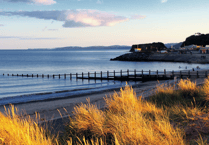
The preferred option is a combination of tidal defence shutters/flood boards fixed to individual riverside properties between Morgan's Quay and the New Quay, and a permanent wall-type structure between the Fish Quay/docks and New Quay.
Boatmen now fear that if a £2.4 million wall from the Ship Inn to Polly Steps is built, it will strip them of 'their long-standing foreshore rights', particularly the use of Gales Hill public slipway and beach for the repair and maintenance of larger boats.
But Tony Brown, a member of the influential South West Regional Flood Defence Committee that will make the final decision on the scheme's future, said that neither the beach nor the slipway would be affected.
The wall has been proposed following an Environment Agency assessment that there is a once-in-50-year risk of flooding from the river into the town, and a once-in-200-year risk of a severe flood disaster.
The agency has already stressed that the final design of the scheme is subject to discussion and consultations were continuing with those directly affected.
In a letter to Defra's fisheries department, a spokesman for the Teign Fishermen & Watermen's Association accepted the need to protect the town from flooding, but said that the plans were 'rather obscure'.
He asked: 'Why is the council going to the trouble of building walls halfway down the beach when flood prevention would be just as effective, if not more so, at the top of the beach? It would also much less disruptive, and more importantly, cheaper.'
Watermen feared that this might be a deliberate act by Teignbridge Council, who in recent years had been far from supportive of the fishermen.
They also questioned why Shaldon, Newton Abbot and the mainline railway, on the same level as Teignmouth, were not being provided with flood prevention.
'It's the association's opinion that this flood scare and the precipitous action demanded by Teignbridge Council has as much to do with infilling the beaches for other uses – such as car parking – as it is for flood prevention,' said the spokesman. 'The irony of the situation is that the council is actually to seek funding from Defra for this ill-considered scheme. So the very Government agency that is there to protect the interests of fishermen is likely to fund a scheme that will put a further blight on the local sea fishery.'
At the time of going to press, no spokesman for Teignbridge Council was available for comment, but the council has previously denied any hidden agenda for the flood defence scheme.
Mr Brown, a Defra-appointed independent representative who lives in Shaldon, confirmed that the wall plans had been extensively redrawn to incorporate public criticisms.
He said that they would go on display at the end of January at the Carlton Theatre and Bitton House in Teignmouth, and at Teignbridge Council's offices at Forde House in Newton Abbot.
The scheme is due to go for planning approval in February, with construction scheduled to start in October 2004.
Mr Brown said that the back beach was absolutely unique and charming, and he would never want to change it.
'I am a local man, and very interested in what is happening, and I believe there is a scientific need for the wall,' he said. 'Still sea levels have been increasing by the thickness of a beer mat at Newlyn every year for the last 20 years. So if you go back 20 years and forward 20 years, that is equivalent to 40 beer mats, which is quite substantial.'
He said that only a few weeks ago there had been a storm surge and a potential flood at Weymouth, which Teignmouth had narrowly missed because of the tides.
The proposed wall was now the optimum height after a lot of rewrite and redesign.
'I do appreciate that people need to see proposals, which is why we have organised them for the end of January,' said Mr Brown. 'I have insisted that a photomontage is on display, putting the scheme in context as if it were finished. There will be a number of alternative views that will show wall with a variety of facings. We want outstanding design and outstanding quality for this historic and important area.
'We should use stone or timber in any parts that can be seen by the public. Concrete is definitely not suitable. The scheme is as good as we can get it, bearing in mind that we've got a major engineering project to protect 400 homes.'
Teignmouth town councillor Susan Dawe said that the watermen had every right to be concerned, and a great many questions needed answering.
There had been insufficient information about the proposals. She said that she was scared by the speed of the scheme.
'The authorities have a lot to learn about consulting the public,' she said. 'It's going to planning in February, and there have been no detailed proposals so far.
'My concerns are very broad, and go right back to Square One. Is there sufficient evidence that we need a flood prevention scheme, and if there is why isn't that evidence public?'
She said that many people would welcome defences if needed, but felt that the scheme was an 'overkill' reaction. What about its impact on fisheries and wildlife?
'Visitors like Teignmouth as it is, as a working place in a beautiful setting,' said Cllr Dawe. 'We need a balanced outcome, giving us protection without going over the top. We cannot afford to desecrate a fabulously beautiful and much-loved area.'
She said that people had told her that her interest in the issue had come as a breath of fresh air. They had not expected councils to be interested in what they thought. 'Teignmouth has been hurt in the past, with schemes like the dual carriageway that split the town in two, and the Co-op,' she said. 'People are pessimistic, and get resigned to thinking a scheme will happen, no matter what they think.
'The council sees that as apathy, but in fact it is the response of people who feel their views have been ignored. People think that these proposals are driven by officials who neither come from this area nor have to live with the consequences.'