
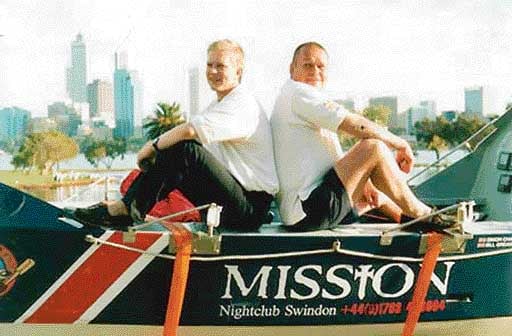
DEFYING death through a long night in shark-infested waters has left Newton Abbot oarsman Simon Chalk a changed man.
'Materialistic things don't matter so much, nor petty things,' he told me in his first interview since returning to Britain following his 15 hour ordeal in the Indian Ocean.
The property developer had been worried about approaching his 30th birthday, but now he says: 'I'm just glad to be nearly 30. I'm going to have a big party.'
Simon and his friend and fellow oarsman Bill Greaves were left clinging to their upturned boat after their record breaking attempt at rowing more than 5,000 miles from Western Australia to Reunion Island off the coast of Madagascar went horribly wrong last month.
And he revealed that the 70-day attempt felt cursed from the start because a break-in and fire at his office in Courtenay Road, Newton Abbot destroyed four-and-a-half-years' work.
'I've lost everything,' he said without a trace of self pity. 'But I still have my life.'
He heard about the destruction at Highwood House while he was waiting for his flight to Australia in April. While that damage is being assessed he knows he has lost £65,000 alone because of the shipwreck.
DEFYING death through a long night in shark-infested waters has left Newton Abbot oarsman Simon Chalk a changed man.
'Materialistic things don't matter so much, nor petty things,' he told me in his first interview since returning to Britain following his 15 hour ordeal in the Indian Ocean.
The property developer had been worried about approaching his 30th birthday, but now he says: 'I'm just glad to be nearly 30. I'm going to have a big party.'
Simon and his friend and fellow oarsman Bill Greaves were left clinging to their upturned boat after their record breaking attempt at rowing more than 5,000 miles from Western Australia to Reunion Island off the coast of Madagascar went horribly wrong last month.
And he revealed that the 70-day attempt felt cursed from the start because a break-in and fire at his office in Courtenay Road, Newton Abbot destroyed four-and-a-half-years' work.
'I've lost everything,' he said without a trace of self pity. 'But I still have my life.'
He heard about the destruction at Highwood House while he was waiting for his flight to Australia in April. While that damage is being assessed he knows he has lost £65,000.
He is on a double mission – both to break the double handed rowing record that eluded them, and to find out why the supposedly self righting boat refused to do just that.
Simon said: 'I feel I let Bill down,' admitting that he had known for the first time about potential survivor's guilt, not knowing if he could have gone on clinging to the boat if – as at one time seemed possible – Bill had slipped away.
The venture began well, with the two men alternating between rowing and resting. They had a plan to get off the continental shelf, where the ocean deepens quickly, as fast as they could.
'In the first two days we made fantastic progress, but we were pretty exhausted and the wind was picking up.'
After a while it became impractical to row and they decided, at the peak of the storm, to get some rest. They battened the boat down, left a line out and Simon fell asleep.
He woke when they were hit by something – possibly a whale – that left them with 'one of those feelings of total helplessness'
The boat turned upside down and it didn't come up again. 'We were both locked in the cabin, upside down, with the water level rising outside,' he said.
They had no idea if the boat was breaking in half or if they were sinking. Their terror can only be imagined.
'It was a surreal kind of feeling because it was quiet,' he said.
Then the questions began, with Simon repeatedly asking Bill if the boat was righting itself while their belongings fell to the floor and an inch of water seeped inside.
They tried walking round the partly submerged cabin in an effort to right the 23-foot long boat – but it didn't work
'We had to get out,' he said with understandable emphasis, but everything they needed, including their wet weather gear, was stored under the deck and they couldn't get at it. Nor could they transmit from their satellite phone because they were upside down.
They took deep breaths and Bill opened the hatch – the force of water hitting them was 'like something out of the movies,' Simon said, and they held their breath until the water filled the cabin.
Then they struck out desperately, Bill to the right and Simon to the left so that they wouldn't get caught up with each other. A much needed lifejacket and beacon became trapped and Simon too got stuck – but found an air pocket under the boat.
With a huge effort he freed himself and found himself floating in the darkness wearing just a pair of shorts, a sodden fleece and a pair of gloves. Bill had only a pair of shorts.
'We were upside down, and nobody knew we were in trouble,' Simon said. 'We had to get help. Bill said if we didn't get a beacon going we'd be dead.'
The waves were breaking over the boat, lifting it and bringing it crashing down again. They managed to get hold of the line and throw it over the boat while they tried repeatedly to free a special beacon, but it refused to come off its mounting.
They had another beacon – and Bill dived to try and free that one and although he couldn't at first free it after a 'last ditch, all or nothing' attempt, it came loose.
After the boat had been upside down for about an hour they finally managed to get the beacon working, which was accurate to about a square mile. 'In an ideal situation you want to get two off,' Simon explained,' so people know it isn't a false alarm. It was a tiny rowing boat in a big ocean.'
He went on: 'There was a feeling of elation that at last people knew we were in difficulty.'
The two men were battered, bruised and bleeding from being knocked about as they escaped from the cabin, and Simon knew there were sharks nearby.
'It couldn't have happened at a worst time. It was just before nine when we went over and there were nine hours before daylight. The chances of survival were looking pretty slim.'
Throughout the long hours of hell they each had to keep one hand on the boat. 'We didn't talk to each other a great deal. I didn't want to share my fears with Bill in case I gave him more fears,' Simon said. But when one of them was down the other did what they could by way of encouragement.
There was ecstasy – then agony – at 3am when they saw lights in the clouds and realised a plane was up there. But even though Simon was desperately holding the beacon above the water, swapping it from one tired hand to another, even balancing it on top of his head at one point, the plane didn't see them.
'That was a really hard time. There was hope, and then it was taken away.' All they had was the little flashing orange beacon – and they began to worry that it wasn't working properly.
In a masterpiece of understatement Simon said that the hours to sunrise were 'quite difficult,' knowing that nine millimetres away was everything they needed for survival – but they couldn't be reached.
Then at 8am they heard the miracle of another plane. This one was operating a grid and Simon held the beacon high again.
The emotion was clearly audible in his voice as he described how it circled back over them, and dipped its wing. 'It was absolutely awesome,' he said.
The plane dropped a huge flare and then there was nothing to do but wait until a ship that had steamed 64 miles out of its way appeared on the horizon.
'We were tired though, and there was still the nagging doubt that you could be taken by sharks at any time,' he said.
After 90 more agonising minutes the ship – a 238,000 ton iron ore carrier Bulk Africa – stopped close by, but despite several attempts at manoeuvering, couldn't get near them.
The images are powerful – a colossal hull, the fear of the sharks, the gigantic bow wave, the new fear – how were they going to get on board?
Then two things happened. The rudder broke of their boat and they lost their ensign.
Seeking the record for Britain they had been flying the British flag and to see it float away was an emotional moment for the two men. 'I know it seems trivial when we were fighting for survival but it was symbolic,' Simon said. 'It's difficult to explain.'
But then the ship was coming straight at them and there was yet another terror – that they would be mown down by the oncoming bow. Heart in mouth Simon waited, having already told Bill that he wanted to be last away from the boat if they were rescued by helicopter.
Then the bow wave hit and they were washed away from the boat and a mad scramble began to try and cling on to the ropes that the crew had thrown over the side.
Without being able to explain how, the two men managed to get a rope each, and in trying to get a grip on a timber and rope ladder they were dragged two thirds of the length of the boat.
The crew lowered a rope noose down and pulled Simon up first. On the deck he just collapsed and was wrapped in blankets. 'I couldn't move,' he said.
There was to be no simple happy ending because after about 30 seconds 'all hell broke loose,' as Bill fell back in the sea. He had slipped from the ladder twice, but somehow the crew got him aboard.
The nightmare was over.
'I didn't pray,' Simon revealed. 'I'm a bit of a hypocrite that way. The boat's blessed and I wear a St Christopher. Bill did and he hasn't prayed for a long, long time.'
Through all his description burned the determination to go straight back to Australia for another attempt. 'We are going straight back out there,' he declared. 'It's our record.'
But there is business to attend to, sponsorship to raise, new plans to make, that self-righting problem to solve (and with it perhaps lives to save) and still that record dream to achieve.
'That will be something incomparable to remember for the rest of our lives,' Simon said. Then taking a deep breath he said, with his gift of understatement: 'There's a lot to do.'