
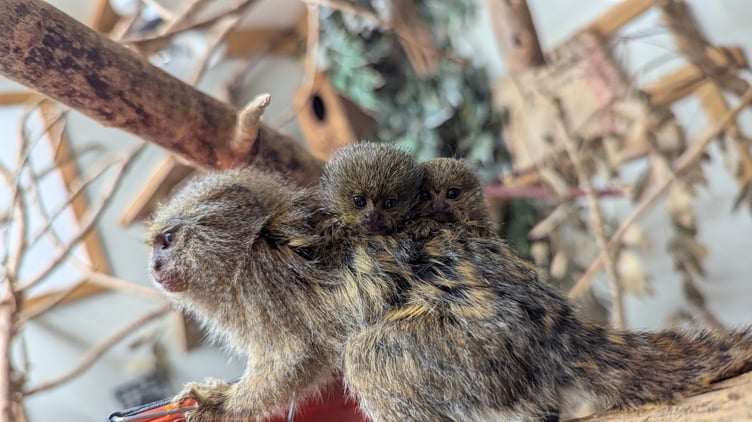
Monkeys don’t get any more miniature than this…
A pair of rare Eastern Pygmy Marmosets, the world’s smallest monkey species, have produced two tiny babies at Shaldon Wildlife Trust.
They’re about the size of a finger and, at birth, weigh just 15 grams – roughly the weight of a single ping-pong ball. Even when fully adult they reach only 12 to 15 centimetres in length.
The twins arrived earlier in July to parents Pablo and Tumble, and are the first to be born at the Shaldon Wildlife Trust in 11 years.
Director Zak Showell said: “We are absolutely over the moon.
"To have our first Eastern Pygmy Marmoset births since 2015 is a huge milestone for our team, but to see how quickly Pablo and Tumble bonded makes it even more special.”
Pablo came to Shaldon from Shepreth Wildlife Park in June 2025, and was joined by Tumble from Dudley Zoo in January this year. They were smitten with each other from the start, and produced their twin babies just six months later.
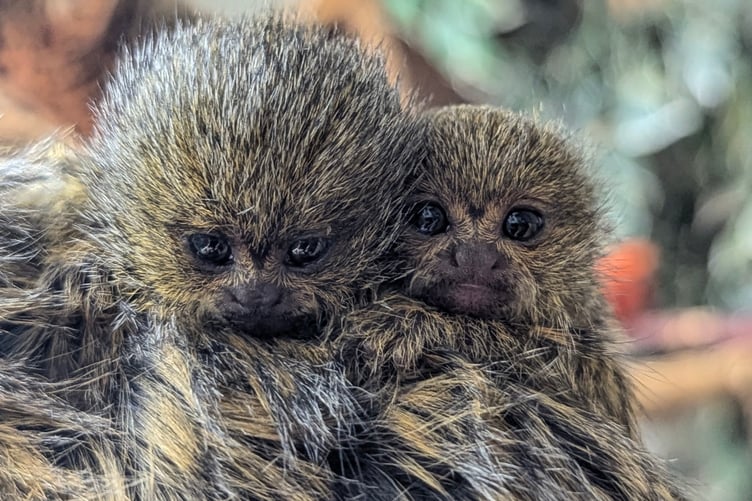
In Eastern Pygmy Marmosets, fathers take on the primary caregiving duties. Pablo has taken to fatherhood well, carrying the twin infants around on his back and only handing them over to Tumble for feeding.
Zak said: "At 19 days old, the twins are doing fantastically well.




“Dads do most of the heavy lifting in marmoset families, and Pablo is an experienced dad, having had several babies at his previous zoo.
“Visitors this summer will need a keen eye, but if you look closely at Pablo’s back, you’ll see two tiny furry faces peeking out over his shoulders!"
Eastern Pygmy Marmosets or Cebuella niveiventris are native to the rainforests of the western Amazon Basin and are famous for their miniature size. They face growing pressures from habitat loss, deforestation and the illegal pet trade.
The species is classed as vulnerable to extinction by the International Union for Conservation of Nature – it’s on the IUCN Red List of Threatened Species, a critical indicator of the health of the world’s biodiversity.
By successfully breeding them as part of a coordinated European breeding network, Shaldon Wildlife Trust is helping to maintain a genetically healthy insurance population for the species, while also raising awareness for rainforest preservation.
Zak said: “Life in the wild canopy requires some incredible adaptations. Pygmy Marmosets are true 'gummivores' with specialised, chisel-like teeth designed to gouge holes into tree trunks to feed on sap and resin.
“To mirror their natural wild diet in Devon, the keeping team provides a carefully balanced daily menu of specialized gum powder, fresh vegetables, and protein-rich insects to encourage natural foraging behaviors.”
The new family can now be spotted in their indoor and outdoor habitats at Shaldon Wildlife Trust.
The baby marmosets are the second significant newborns to arrive there this summer.
In May the Shaldon Wildlife Trust made national and international headlines after a pair of critically endangered red-ruffed lemurs produced quadruplets – an incredibly rare phenomenon, seen in only six per cent of births worldwide.
Comments
This article has no comments yet. Be the first to leave a comment.