
FRIDAY'S high court decision to overturn the legal right to camp on Dartmoor without the permission of the landowner has been met with sadness, anger and a determination to resist.
Dartmoor is the sole remaining area of England and Wales where wild camping in designated areas is legal, without any landowner’s permission. It's thought that people have been camping on Dartmoor for over 100 years, with Dartmoor's bylaws seemingly legally protecting the practice in the 1985 Dartmoor Commons Act.
However, this right is being challenged by landowner Alexander Darwall, who questions the legal basis of wild camping, despite outrage from local people, hikers and environmentalists. Among other landowners, Darwall and his wife argue that the legal basis for camping on Dartmoor never actually existed, as the 1985 act never explicitly mentions camping.
Sir Julian Flaux, the chancellor of the high court, ruled: 'In my judgment, on the first issue set out at [14] above, the claimants are entitled to the declaration they seek that, on its true construction, section 10(1) of the 1985 Act does not confer on the public any right to pitch tents or otherwise make camp overnight on Dartmoor Commons. Any such camping requires the consent of the landowner.'


Dr Kevin Bishop, Chief Executive for the Dartmoor National Park Authority, said: 'We are really disappointed with the outcome but obviously respect the judgment. We will now consider our position carefully before deciding on whether to appeal and on what grounds.
'We maintain that wild camping is an important form of open-air recreation and is a way to enjoy the special qualities of the National Park – for example, the dark night skies, sense of wilderness and the tranquillity that can be derived from the commons of Dartmoor. Done properly, and with respect, it has little impact on the environment.
'We are keen to work with landowners and other stakeholders to see how we can sustain opportunities for people to wild camp on Dartmoor.'
Tom Sigler is a software designer from Wiltshire. At the age of 30, Tom was diagnosed with Crohn’s disease. Tom found that the only truly effective therapy for his illness was hiking outdoors. To read more about his story, click the article below.
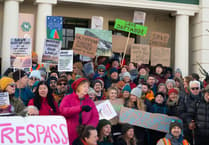
Tom has since become a leading figure in the battle against Darwall, helping to organise the recent rallies. On the ruling, Tom said: 'I’m definitely disappointed, it’s not the verdict that we wanted. Moving forward we’ve got to be hopeful that there’s a way to appeal it
'It’s particularly disappointing because it’s a national park, and if anything, it should be going the other way.
'I’m hoping that a positive may come out of this, that this court decision will act as a catalyst to hopefully not just overturn this decision but also push it into other national parks, to give the public more access to those as well.'
A regular hiker across the country, Tom now runs an Instagram page, Hike_Britain, which promotes hiking and the outdoors. The page now has over 100,000 followers. However, Tom isn't just worried about the hiking community, but about those who are new to the pursuit. 'I wild camp all over the country, but I personally won’t be camping on Darwall’s land at all,' said Tom, 'because he has the resources and the intent to defend his land, and if he has the opportunity to prosecute, then he undoubtedly will. Because this has just happened, the enforcement of preventing wild camping will now be a top priority, and it seems that other landowners back what Darwall has been doing.
'So it makes me more wary of camping on Dartmoor, but in general, it ends an over 100-year tradition of camping on the moor, that’s what it does, it’s absolutely shocking. So it’s going to make wild camping less accessible, families are not able to camp anymore, fewer people are going to be able to camp, and if anything, I think it will encourage irresponsible wild camping.
'There are so many areas, including many national parks, that are commons, they’re meant to be for the public, but they’ve been privatised. National park: the clues in the name. There should be some sort of national right to do activities in those parks responsibly.'
The Ramblers, a charity promoting hiking and the outdoors, said: ‘This decision is a huge step backwards for the right of everyone to access nature.
'We support the long-established precedent of wild camping across Dartmoor Commons and we’ll fight with Dartmoor National Park Authority to defend our rights of access and overturn this result.’
For some, the ruling came as a surprise. Angela Vanstone has been hiking across the moor since she was a child. Living on the moor and in Newton Abbot more recently, Angela only began to understand her rights as they were being taken away. 'I never even understood Dartmoor's laws until now,' said Angela, 'now, I'm an expert!'
'I just don't think it should be the case that rich people can come to our beautiful national park, buy huge areas of it, and then start moving the goalposts.'
Tom Sigler also questioned Dartmoor National Park Authority's capacity to defend the right to camp, given their recent budget cuts. 'Another part of the problem is going to be funding cuts. Dartmoor visitor centre in Princetown is closing, they’re having to find cuts everywhere.
'The cost of putting something through court, Darwall has got huge resources, he’s got the best possible lawyer for this case. Has Dartmoor National Park got the best possible defence for this? Probably not, because they’re not going to be able to afford it.
'What’s next? The general consensus is working out how this decision can be appealed, that’s what we’re all working at right now.'
Richard Foord, MP for Tiverton and Honiton, weighed in on the case: ‘I am deeply concerned by today’s ruling to allow curtailing of wild camping at Dartmoor.
‘As a child, I wild camped on Dartmoor when training for the Ten Tors expedition and for the Duke of Edinburgh Award. Without these experiences, I would not have joined the Army or trained to be a Mountain Leader.
‘Like many people across the South West, I regularly enjoy getting out into nature with my children and spending evenings camped under the stars. Restricting people’s right to do this is damaging and will really limit the opportunities our kids have to explore the countryside.
‘We must protect people’s right to respectfully enjoy our green spaces and national parks. They must remain open and accessible, not closed off. I will seek to raise this issue in Parliament next week and push for action to safeguard this historic right.’
Comments
This article has no comments yet. Be the first to leave a comment.