
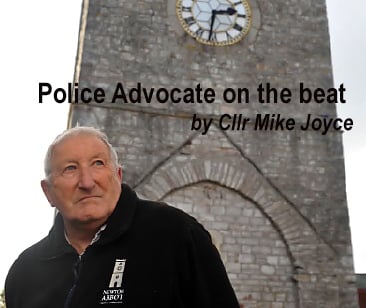
POLICE Advocate Cllr Mike Joyce continues his interview with Deputy Chief Constable Jim Colwill and asks where policing will be in the next five years.
As part of this process, he said he would like to feel that policing reconnected with the public in a far better way than in the past.
New technology, new challenges, new ways of working have brought about what he believes to be the changing and challenging face of policing and the frustration and perception of the public and businesses to that change.
The DCC stated that we all have a lot to do, especially in the force to continually work to ensure the public have faith in the service and its officers.


But equally, the public must show an understanding of the pressures the Force and its officers are under. It must be a partnership that works for everyone.
The DCC explained that on average, 75% of officers’ time is now dealing with some form of mental health concerns.
The list is extensive, but this can be through illness, drugs, or antisocial behaviour.
The challenges this alone brings to the force is of major concern, not only with officers’ time but with the challenges of ensuring that the persons that fall under this category remain safe and secure.
An example that was given was that a person who has a mental illness is brought into custody for their own safety, whether it be under the Mental Health Act or other means, even though the person may eventually be able to be discharged or released, sometimes this cannot happen because there is nowhere for this person to be placed in a safe environment.
So, officers are allocated to ensure that they are well looked after while in police custody.
This ties up officers who could be resourced into other policing activities.
In addition, the cost of providing this safe environment is borne by the force in general and is not compensated through any means of social care on NHS yet it could be argued that it is part of that system.
The DCC stated he wasn’t trying to blame anybody for the situation that forces, not just Devon and Cornwall, but throughout the country finds themselves in, but the reckoning must be made that, if officers’ time is tied up with social services type of welfare, they are not out doing other policing activities, part of which is reassuring the public by having a visual presence.
I then touched on the subject of the police advocates scheme asking the DCC whether, in his opinion, the scheme actually offered an advantage to the force or was it just another avenue that took up officers’ time with little or no reward.
In his reply, the DCC stated that in Devon and Cornwall and the Isle of Scilly, the advocate scheme was very good in places but in others he felt that there needs to be more emphasis placed upon the scheme, to make it more appropriate for that area.
This may be the fault of officers within that area not engaging with the scheme fully or that councillors are not fully aware of the benefits of the scheme and what it brings to communication and cooperation between the local police and them.
I stated that I understood where the DCC was coming from and that there may be a way forward and this was for a joint force, OPCC and advocates approach to those areas which could be highlighted as needing support and encouragement.
The DCC stated that another challenge was the continuing concern by the force and by the public of the 101 and 999 services.
In his opinion, it highlighted that on many occasions, people’s perception of the 101 service was that it was a 24/7 availability, not just for policing matters but for a host of other enquiries, that usually fall outside the remit of what the service was designed to cope with.
I enquired whether he thought the problem facing the 101 service was partly down to the force together with the OPCC, police advocates and other sections encouraging the public in many forms and guises, to report anything and everything to the 101 service.
Whether it is a suspicious person, a suspicious vehicle, and a suspicious act or a concern, by that very means are we not contributing to the problem as well as trying to solve the problem that we may have created ourselves unwittingly.
The DCC stated that we probably have but he did not want a situation whereby people stopped reporting things, even though they may turn out to be minor or insignificant. Sometimes within all the things that are reported, there is a snippet of something that leads to bigger things, a solution to an ongoing investigation, it takes just that one snippet to make a difference.
So yes, we may be the architect of our own downfall to some extent, but to do away with it could also lead to more significant problems further down the line. The DCC accepted it is a very careful balancing act but one that must be kept under constant review to ensure that it is meeting the aims it was designed for.
Another item we discussed was speed watch and how it has benefited the communities by bringing communities together to address the situation within their patch. We also discussed the opening of closed police station public enquiry offices to return to providing a visual presence that people could relate to and seek advice or cooperation from officers and others within a station that is there for them.
In conclusion the DCC agreed that with the ever-changing aspirations of the public and businesses, with the ever-changing challenges that face the force, the role that he now occupies and the role of his colleagues namely the ACCs will continue to evolve as circumstances change but the bottom line is that officers of all ranks are there to serve, protect and offer a safe and reliable police force respected by all and open to all.
I thanked the DCC for the opportunity to discuss policing with him, his role, his ambition, and the future as he sees it for the whole of Devon and Cornwall Police.
Comments
This article has no comments yet. Be the first to leave a comment.