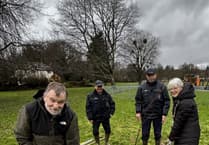
farmers are working with Action for Wildlife to halt and reverse the decline in Buckfastleigh's bats. The problem is a national one, says Frances Cooper, Action for Wildlife officer. Over the past century the number of greater horseshoe bats has dropped by 90 per cent with changes in farming practices and the decreasing number of bat-friendly old barns all being held to blame. Buckfastleigh has the largest breeding colony for horseshoe bats in western Europe, with around 1,000 adults and 500 juveniles. It is of huge conservation importance. English Nature has provided funding to help Action for Wildlife, the Dartmoor Biodiversity Project, to work with farmers and landowners to make changes which are often small for humans but vital for bats. 'One of the most crucial factors is feeding habitat. Bats don't like to fly very far from cover. Tall hedgerows with full grown trees provide continuous sheltered flight corridors,' said Mrs Cooper. By radio-tracking the bats, it was discovered that they feed within a triangle between Buckfastleigh, Dartmeet and Widecombe-in-the-Moor. Earlier this year about 130 trees were planted in hedgerows on five farms around Scoriton, the heart of the bat foraging area. Farmers have also been advised not to trim hedgerows annually – at least not on top – to minimise disturbance and predation during the dusk feeding forays. Bats' favourite feeding grounds are cattle-grazed pasture and wildflower-rich haymeadows, which support high numbers of insects. 'They feed on moths and crane flies. In the summer after the young bats are weaned, they rely particularly on dung beetles, which are associated with beef cattle and ponies.' Modern worming formulations – commonly avermectin-based products – have led to fewer dung beetles, but Mrs Cooper said that there are substitutes which farmers can use. Through the Environmental Stewardship Scheme and other schemes, farmers can receive financial assistance to help them adopt more bat-friendly and wildlife-friendly practices.