

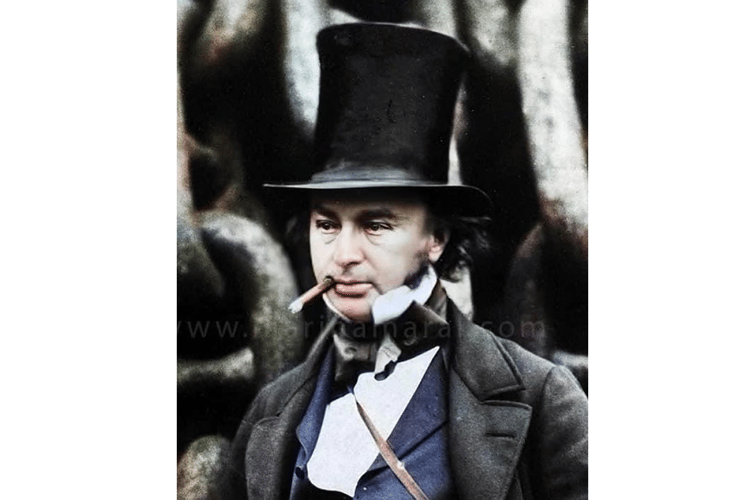
PLEDGES of money have already started to come in to support a proposal to erect a statue of Victorian engineer Isambard Kingdom Brunel in Dawlish.
Hundreds of people have come forward to support an idea for a memorial to recognise the man who brought the railway line to the town.
Historian David Force came up with the suggestion to commission a life-size statue of Brunel as a way to mark the completion of the multi-million pound project to protect the vulnerable coastal line.
David said: ‘There has been a very positive response from hundreds of people to the suggestion of a statue of Brunel near the seafront in Dawlish.



‘Indeed, I have already had offers of money towards the cost.
‘There will be a concerted effort in the New Year to make it happen in some way or another, probably by way of a crowd-funding campaign.’
Isambard Kingdom Brunel was one of the most innovative engineers in history who brought the railway to Dawlish in 1846.
Statues of Brunel can already seen along other parts of the Great Western network including Bristol and Swindon.
The idea has been mooted before over the years but now the end of Network Rail’s extensive resilience work could be in sight, David thinks a statue would be a fitting way to mark that and Brunel’s contribution to the history of Dawlish.
He is also suggesting a story board explaining how Brunel’s railway cemented the town’s place as a holiday resort in Victorian times which continues today.
While there have not been any costings, it is thought the project could cost in the region of £20,000.
David believes a statue could also be an attraction for tourists and a ‘fitting tribute’ to Brunel.
His idea has prompted a raft of support with comments calling it ‘fabulous’, ‘fantastic’, ‘brilliant’ and ‘superb’.
One said it would be a ‘great tribute to a great man and town’ and another saying ‘Dawlish should absolutely have this’.
David is working with Neil Salter from the Chamber of Trade to investigate the possibility of a statue.
The line from London to Bristol began in the 1830s and by 1840, Brunel was buying land to extend the line to Plymouth along a route through Dawlish.
The project involved building a seawall from Dawlish Warren to Dawlish and between Holcombe and Teignmouth.
He also had to blast five tunnels through the rocks between Dawlish and Teignmouth.
Comments
This article has no comments yet. Be the first to leave a comment.