
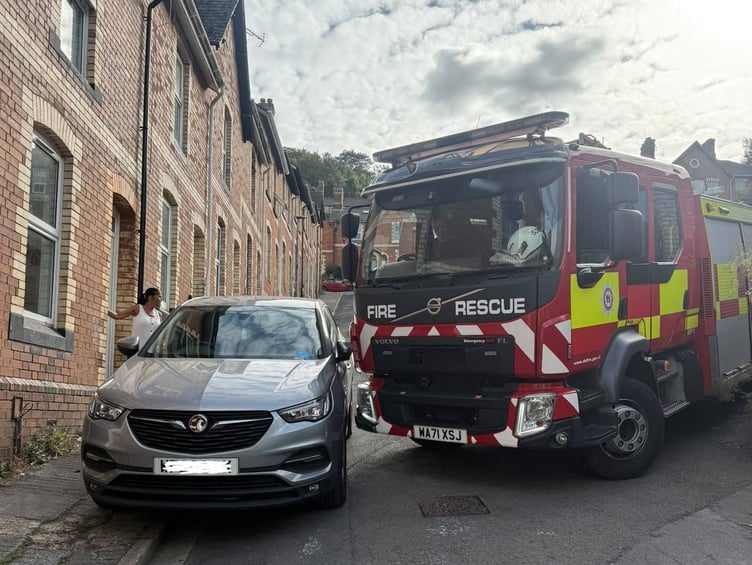
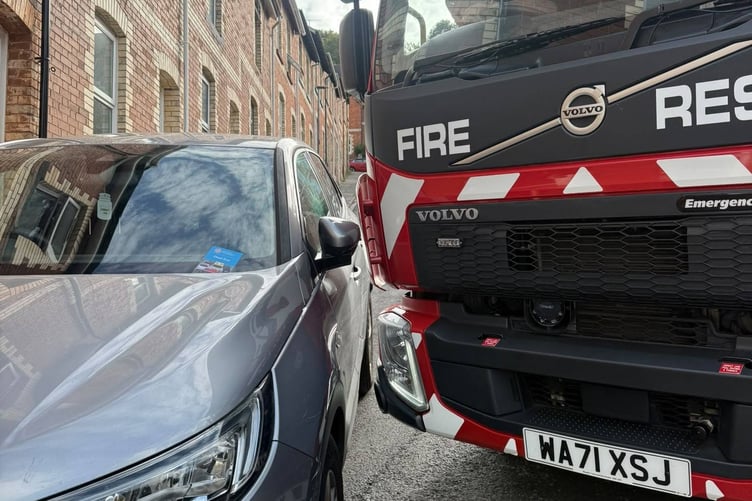
The potentially tragic consequences of careless parking are being flagged up by Newton Abbot firefighters after this incident, captured on camera by the crew.
Responding to a call-out at Haydon Court flats, off Western Road, they couldn’t drive into the entrance because of a car parked opposite. They had to drive past and reverse in.
It turned out that the fire alarms had been triggered by burnt food, so the delay didn’t endanger any lives.
But it could have. That’s why the crew took photos as they manoeuvred their fire engine out again afterwards, and posted the pictures on social media.
Crew Commander Jordan Leaman at Newton Abbot Fire Station said:
“We are not trying to scaremonger or exaggerate the issue of poor parking; we are simply trying to educate and hopefully bring some awareness to this issue and highlight the potentially fatal consequences.”
A few years ago, he and his crew couldn’t get to a burning house in Newton Abbot because there were so many parked cars in the street.
“We were forced to abandon the fire engine and run the remaining distance of 400 metres or so. One fire appliance alone doesn’t have enough hose to cover those distances, therefore we had to await other appliances who then had the same access issues, until we had enough hose to reach the fire.
“As you can imagine this took a considerable amount of time and significantly reduced our effectiveness in tackling this fire.”



So why can’t fire crews just force their way past, ramming the parked vehicles out of the way?
“Causing damage to other vehicles is a last resort for us when responding to an emergency call. Our first option is to always attempt slow speed manoeuvring around parked vehicles and tight access areas.
“Following on from this however, crews would look to try and find the owner by pounding on doors and blasting the sirens to attract attention.
“The next step would be to try and move the vehicle by bouncing it, however with modern vehicles becoming heavier and fire appliances often minimally crewed (four firefighters) this technique is not as effective as it was 10 or 15 years ago.
“As an absolute last resort, and only in a life-or-death situation, would we consider damaging a vehicle to proceed.”
That’s partly because they would risk damaging their own fire engine, putting it out of action for responding to the call-out or incurring costly and time-consuming repairs afterwards. The fire service would also be liable for any damage caused to a third-party vehicle.
Crew Commander Leaman said firefighters aren’t asking for permission to ram vehicles out of their way - they just want people to consider emergency access when parking.
“We truly are aware that parking can be a premium and seems to be getting harder by the day. We also understand that parking your vehicle away from your property is inconvenient, but in response to that I would offer up this thought: What if someone died on your street because of a house fire and our actions as firefighters had been delayed as a result of your irresponsible parking? Although the fire wouldn’t be your fault, how easily would that sit on your conscience?”
Comments
We've recently changed our login process. If you have an account for commenting, you will need to re-register on the login window.
This article has no comments yet. Be the first to leave a comment.