
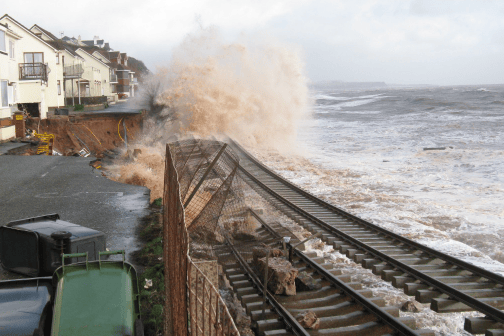
THE majority of Devon’s flood defences are in good repair and above the required standard, according to national analysis.
All of Devon’s councils have 10 per cent or fewer of their flood defences listed as ‘below required condition’ (BRC), according to exclusive figures obtained by the BBC Shared Data Unit.
Those numbers show, as of 20 October this year, 8.6 per cent of the 98,466 defences inspected in England by the Environment Agency fell below their required standard.
About 6,500 of those below condition are considered ‘high consequence’, meaning they are meant to protect multiple homes or businesses.



While the Department for the Environment, Farming and Rural Affairs (Defra) says the situation has improved since the same time last year following record levels of investment, stark disparities remain at local authority level.
However, Devon appears to have fared strongly.
The seven councils in Devon covered by the data – East, Mid, West Devon, the South Hams, Teignbridge, Torridge and Exeter – had a range of five per cent to one per cent as BRC.
While Devon has emerged well from the analysis of flood defences, it has had some high-profile flooding events.
A 2021 report by Devon Climate Emergency stated that ‘flooding and coastal erosion also present a very serious risk to public assets, critical infrastructure and transport across Devon, Cornwall and the Isles of Scilly’.
‘In February 2014 a failure of the seawall at Dawlish resulted in the closure of the main line railway to London for two months.
‘The resultant repairs and other strategically planned improvements to increase rail resilience between Exeter and Newton Abbot will cost tens of millions of pounds to deliver,’ it said.
That study concluded 130,000 homes across Devon, Cornwall and the Isles of Scilly were at risk of suffering a flood event with a 0.1 per cent chance of occurring every single year, but a significant proportion of those were at risk of ‘much more frequent flooding’.
Elsewhere, the Devon Resilience Innovation Project (DRIP), which includes experts from the University of Exeter, won a national award earlier this year at the Environment Agency’s Flood and Coast Excellence Awards.
The project runs until 2027, working with 19 organisations to improve resilience to flooding in 26 communities across Devon.
Many of the communities selected would not typically be high priority within the local flood risk management strategy due to the low numbers of properties at risk.
It is a unique project to help neighbourhoods be better prepared for and able to recover more quickly from flooding by improving community resilience.
In April, Floods Minister Emma Hardy told MPs that 3,000 of the Environment Agency’s 38,000 high-consequence assets were in the “poorest condition on record” following “years of under-investment”.
The Environment Agency’s target is for just two per cent of its high consequence defences to be below target condition. The current figure is near nine per cent.
Comments
We've recently changed our login process. If you have an account for commenting, you will need to re-register on the login window.
This article has no comments yet. Be the first to leave a comment.